
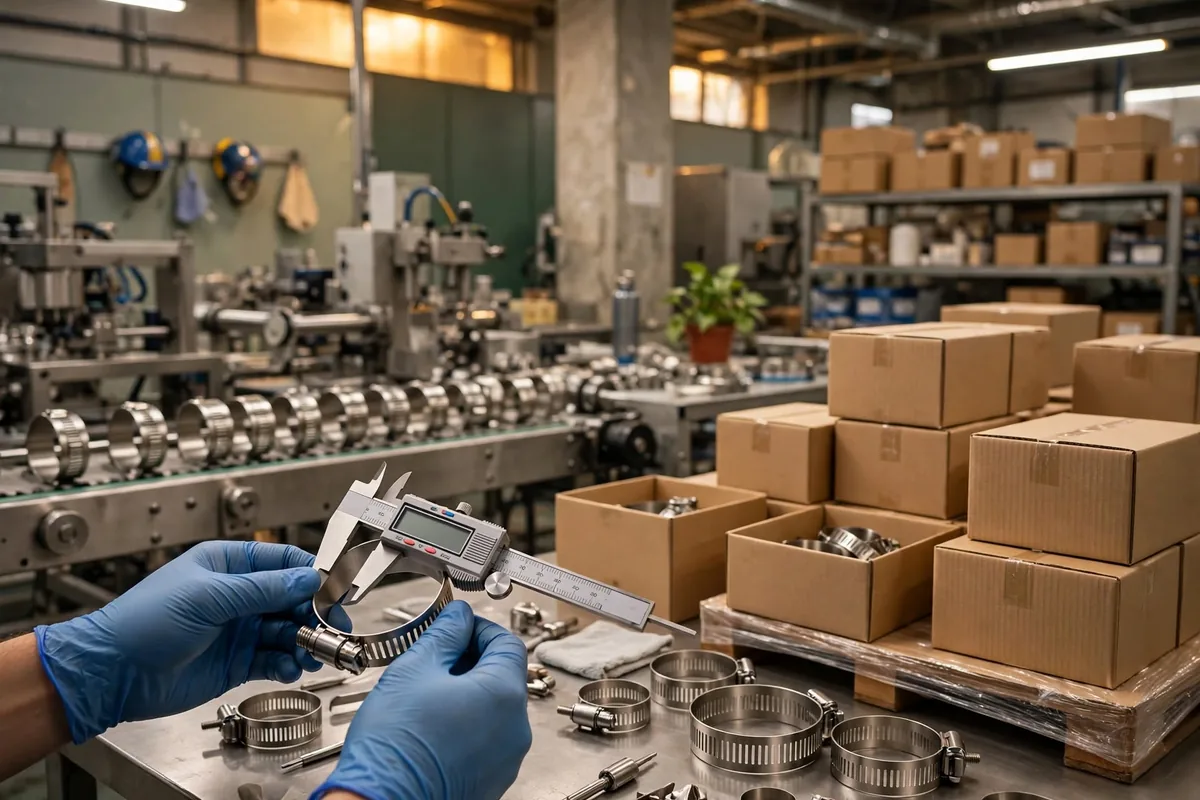
Choosing a hose clip manufacturer in India isn’t just a hunt for the lowest quote. A hose clip is a tiny part, but when it fails it can stop a machine, leak a fluid or send a vehicle back to the workshop. Experienced buyers know this, so they ask tougher questions about quality, standards and support before they place an order.
Here’s a practical checklist you can use when comparing manufacturers. It’s written for procurement managers, OEM sourcing teams and distributors, and we’ve kept the jargon out. (One quick note: “hose clip” and “hose clamp” mean the same product, and most suppliers use both terms.)
Why India Is a Credible Source for Clamps
Clamps are a small piece of a much bigger story. According to the Automotive Component Manufacturers Association of India (ACMA), the country’s auto component industry reached a turnover of ₹7.6 lakh crore in FY26, up 12.7% on the year before. ACMA also reported that exports grew 5% to USD 24 billion, with Europe showing the strongest growth.
Those figures cover the whole auto component sector, not clamps on their own. Still, they tell buyers something useful: global customers are sourcing more from India, and Indian manufacturers are used to meeting OEM expectations on quality and delivery.
What to Check Before You Choose a Hose Clip Manufacturer
Use these eight points as your checklist. A good manufacturer will be happy to answer every one of them.
1. Quality Certifications
Ask for current certificates and look closely at the scope. For automotive supply, IATF 16949 is an important one. ISO 14001 covers environmental management and ISO 45001 covers occupational health and safety. Jolly Clamps holds all three. Whoever you’re talking to, verify the certificates yourself rather than trusting a logo on a website.
2. Process Control
A certificate tells you a system exists. Process controls show you how it works day to day. Ask which methods the manufacturer uses to stop defects before they happen. At Jolly Clamps we use SPC, FMEA, Poka-Yoke and control plans, along with inspection tools at different stages of production.
3. Standards
Find out which standards the clamps are made to. Jolly Clamps manufactures worm drive clamps, T-bolt clamps and V-band clamps as per SAE and DIN standards. If your customer drawing points to a specific standard, get it confirmed in writing.
4. Materials and Traceability
Ask where the raw material comes from and how it’s checked. Good manufacturers inspect incoming material and can trace a finished batch back to its source. You’ll be glad of that the day you have to investigate a problem or get through a customer audit.
5. Product Range and Customisation
A supplier with several clamp types can usually recommend the right one for your job, instead of pushing the only one they make. Jolly Clamps makes worm drive clamps, T-bolt clamps, V-band clamps, customised clamps and couplings. If your application is unusual, ask whether they can develop a custom design.
6. Testing and Validation
Ask what’s tested in-house and how often, and ask to see a sample inspection report. A manufacturer who can’t explain its testing process is a risk.
7. Lead Times, Packaging and Stock
Get realistic lead times, and find out how urgent orders are handled. Check the packaging options too, whether that’s bulk, boxed or labelled for your distribution channel.
8. Export Readiness
If you ship overseas, ask about export documentation, labelling and experience with your destination market. Jolly Clamps supplies customers on several continents.
Why the Lowest Quote Is Not Always the Lowest Cost
A cheaper clamp looks great on a purchase order. The real cost tends to show up later, when a clamp loosens, corrodes or fails early. Then you’re dealing with warranty claims, line stoppages, extra inspections and awkward conversations with your own customers. So when you compare quotes, look at the whole picture:
- The material grade and finish of every part, not only the band
- Whether quality documents and test records come with the order
- How consistent the product is from one batch to the next
- Packaging that protects the clamps in transit and storage
- The support you get if something goes wrong
Sustainability and Compliance Questions Buyers Now Ask
More buyers, especially those supplying customers overseas, now include environmental practices in their supplier checks. Jolly Clamps says on its website that it focuses on recyclable materials, eco-conscious coating technologies and cleaner energy use, in line with CBAM-aligned practices. If this matters to your business, ask any supplier to explain what they actually do, show the supporting documents and tell you how it applies to your product.
Mistakes Buyers Often Make
- Choosing on price alone, without comparing material, standards and testing.
- Skipping samples and finding fit issues only after a bulk order.
- Not confirming the standard, which leads to mismatched dimensions or performance.
- Ignoring the application, for example using a general-purpose clamp where a heavier-duty style is needed.
- Not checking support, such as who handles technical questions after delivery.
OEM, Distributor or Aftermarket Buyer: What Changes?
What you need from a supplier depends a lot on where you sit in the chain.
| Buyer type | What matters most | Questions to ask | What to look for |
|---|---|---|---|
| OEM | Consistency, approvals, supply continuity | Which certifications do you hold? How do you manage change control? | Documented quality system and a clear approval process |
| Distributor | Range, availability, packaging | Can you supply mixed ranges? Is private labelling possible? | Wide catalogue, dependable stock and clear labelling |
| Aftermarket | Fit, reliability, brand reputation | Do you support different sizes and applications? | Consistent quality and easy part identification |
Questions to Ask in Your First Supplier Meeting
- Can you share your current quality certificates?
- Which standards do your clamps follow?
- How do you verify raw material?
- What testing do you perform on finished clamps?
- Can you provide samples before a bulk order?
- How do you handle customisation requests?
- What are your usual lead times?
- Who will be my point of contact after the order?
Red flags to watch for: no certificates, vague answers about materials, no samples, no testing records, and pressure to place a large order right away.
How to Get a Faster, More Accurate Quote
You can save days of back-and-forth by putting the right details in your first message. Tell us the clamp type, the size range or hose diameter, your preferred material, the quantity, the standard or drawing you follow, the application, and any packaging or labelling needs.
Not sure which clamp suits your connection? Just say so, and describe the hose, the fluid and the operating conditions. Our engineering team can usually suggest an option from there.
Ready to Evaluate Jolly Clamps?
Send us your drawing, size range or application, and we’ll review it and come back with a recommendation and quote.
Frequently Asked Questions
1. What is the difference between a hose clip and a hose clamp?
Nothing, really. They’re the same product. “Hose clip” is the more informal name used in some markets, while “hose clamp” is more common in technical and industrial settings.
2. How do I know if a hose clip manufacturer is genuine?
Ask for current certificates, visit the plant if you can, request samples and check customer references. A genuine manufacturer will be open about its processes and testing.
3. Which certifications should a clamp manufacturer have?
It depends on your industry. For automotive supply, IATF 16949 is important. ISO 14001 and ISO 45001 show environmental and safety management. Whatever they claim, verify the certificate scope.
4. Does Jolly Clamps manufacture to DIN and SAE standards?
Yes. According to the company’s product information, Jolly Clamps manufactures worm drive, T-bolt and V-band clamps as per SAE and DIN standards.
5. Can I order customised clamps?
Yes. Jolly Clamps offers customised clamps for specific requirements. Share your drawing or application details and the team will review feasibility.
6. Do you supply samples before bulk orders?
Ask the sales team about sample availability for your size and type. Samples are the best way to check fit and quality before you commit to a bigger order.
7. What materials are hose clamps made from?
Stainless steel is widely used because it resists corrosion, with different grades for different environments. Confirm the grade for every part of the clamp, including the screw and housing.
8. Do you export hose clamps?
Yes. Jolly Clamps manufactures and exports clamps and supplies customers across several continents.
9. How long does it take to deliver an order?
It depends on the product, the quantity and whether the clamp is standard or customised. Ask for a written lead time with your quotation.
