
By Jolly Clamps Team | Last updated: October 2026
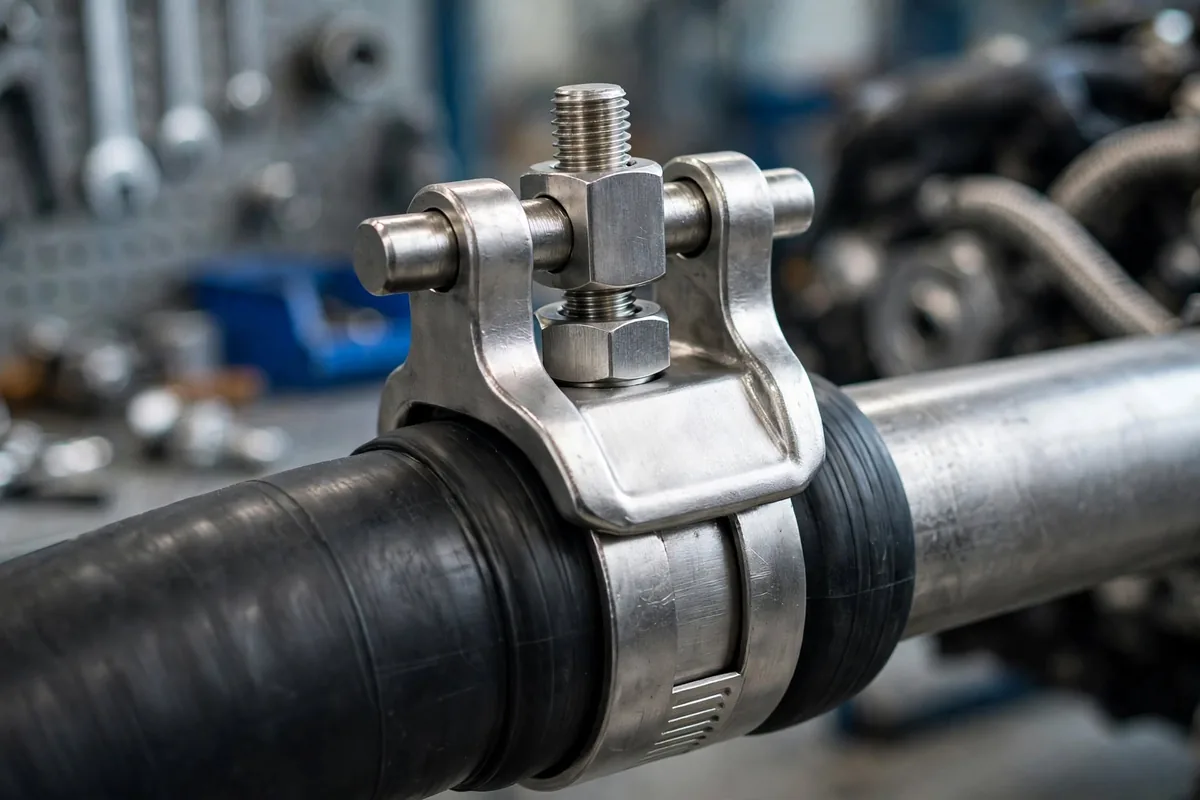
A T bolt hose clamp is a heavy-duty clamp that uses a T-shaped bolt and a nut to pull a strong band tight around a hose. If you’ve ever watched a standard clamp work loose on a large or demanding hose connection, a T-bolt clamp is probably the upgrade you were after.
Below we walk through how a T bolt hose clamp works, how it compares with a worm gear clamp, where it’s used, and how to size and install one properly. We’ve kept it practical, so it should be useful whether you’re a buyer, a maintenance engineer or a workshop owner.
How Does a T Bolt Hose Clamp Work?
A T-bolt clamp has a band that wraps around the hose, with two ends that get drawn together by a bolt and nut. As you tighten the nut, the band closes around the hose and presses it onto the fitting underneath.
Compared with a screw-and-slot clamp, the clamping action comes from a bolt, which makes it easier to apply a strong and controlled load. Many T-bolt clamps also have a bridge or similar part under the bolt area, which helps the band sit evenly. We explain the difference between the two bridge styles in our post on floating vs fixed bridge T-bolt clamps.
T Bolt Clamp vs Worm Gear Clamp
Both clamps hold a hose in place, but they suit different jobs. Here’s a simple side-by-side.
| Worm gear clamp | T bolt clamp | |
|---|---|---|
| Tightening method | Screw turning through slots in the band | Bolt and nut pulling the band ends together |
| Adjustability | Covers a wide range of hose sizes | Matched to a narrower size range |
| Typical use | General-purpose hose connections | Heavier-duty and demanding hose connections |
| Clamping action | Good for everyday use | Designed for a firm, even hold |
| Installation | Quick with a screwdriver or nut driver | Needs a spanner or socket for the nut |
If your connection is a standard one with moderate demands, a worm gear clamp may be perfectly fine. If you need a stronger, steadier hold, look at a T-bolt design.
Where Are T Bolt Hose Clamps Used?
T-bolt clamps are popular wherever hoses are large, heavy or put through a lot. Typical uses include:
- Heavy vehicles and engines: coolant, air intake and charge-air hose connections.
- Silicone and reinforced hoses: where the hose material needs a clamp that spreads the load evenly.
- Industrial equipment: pumps, compressors and process lines.
- Generators and machinery: where vibration is part of daily operation.
Floating Bridge vs Fixed Bridge in Brief
The bridge is the part under the bolt that supports the band. On a fixed bridge, it’s attached to the band. On a floating bridge, it can move slightly, which helps the band close around the hose more evenly as you tighten it.
How to Size a T Bolt Hose Clamp
- Measure the hose outside diameter after the hose is fitted onto the pipe or fitting.
- Choose a clamp range that includes this measurement comfortably, not right at the extreme end.
- Check the band width. A wider band spreads the force over a larger area of hose, and the right width depends on your hose and application.
- Consider the hose material. Silicone, rubber and reinforced hoses all behave differently under clamping load.
- Think about the environment. Heat, vibration, moisture and chemicals all influence the material and finish.
- Confirm the material of every part, including the band, bolt, nut and bridge.
How to Install a T Bolt Hose Clamp Correctly
Even a good clamp can leak if it’s installed badly. Here’s the order we’d follow:
- Inspect the parts. The band, bolt and nut should be clean, straight and free from damage.
- Position the clamp over the part of the hose that sits on the fitting, away from the very end of the hose.
- Check that the band sits evenly and the bridge is properly placed.
- Tighten gradually, checking at intervals around the band so it closes evenly.
- Follow the manufacturer’s torque guidance for your equipment. Please don’t guess.
- Re-check after the first period of use, because hoses can settle or relax once they’ve been through a few cycles of heat and pressure.
A tip many technicians learn the hard way: never use a clamp that’s bent, stretched or corroded. Replace it. A new clamp costs far less than a failed hose connection.
Choosing the Right Material and Finish
Most T-bolt clamps for demanding applications are made from stainless steel, but the grade, the bolt and the finish can all differ. It helps to picture where the clamp will actually work. Inside an engine bay, it faces heat and vibration. Near the coast, or on a vehicle exposed to road salt, it faces corrosion. In a chemical plant, it may face something else entirely.
Tell your supplier about the conditions so the material is matched to the job, and confirm the grade of each part rather than assuming they’re all the same.
A Simple Inspection Checklist
T-bolt clamps are tough, but they still deserve an occasional look, especially on equipment that runs hot or vibrates. During routine maintenance, check these points:
- Is the band free from cracks, deformation or heavy corrosion?
- Is the bolt straight, and are the threads clean?
- Does the nut turn smoothly?
- Is there any sign of leakage or staining around the hose end?
- Has the hose shifted or worn under the band?
If you find any of these problems, replace the clamp and check the hose too.
Common Mistakes to Avoid
- Over-tightening. More force isn’t always better, and it can damage the hose or the clamp.
- Using the wrong size. A clamp at the edge of its range won’t seat well.
- Ignoring the material. A clamp that suits a dry workshop may not suit a coastal or chemical environment.
- Skipping the re-check. A quick look after the first run can catch a loosening clamp early.
Why Choose Jolly Clamps T Bolt Clamps
We’ve been making clamps for more than 50 years and we supply OEMs and industrial customers. Our T-bolt clamps are made as per SAE and DIN standards, as stated on our product pages, and production is supported by SPC, FMEA, Poka-Yoke and control plans along with IATF 16949, ISO 14001 and ISO 45001 certifications.
Need a T Bolt Clamp for Your Application?
Share your hose size, material and operating conditions, and our team will recommend a suitable clamp. Request a quote or explore our custom clamp options if you need something made to your drawing.
Frequently Asked Questions
1. What is a T bolt hose clamp?
It’s a heavy-duty clamp with a metal band that’s tightened by a T-shaped bolt and a nut. It’s used on hose connections where you need a firm, even grip.
2. What is the difference between a T bolt clamp and a worm gear clamp?
A worm gear clamp tightens with a screw that engages slots in the band, and it covers a wide size range. A T-bolt clamp tightens with a bolt and nut and is often chosen for heavier-duty or demanding connections.
3. Where are T bolt clamps commonly used?
On heavy vehicles, engines, industrial equipment, generators and machinery, especially with larger or reinforced hoses such as silicone hoses.
4. Can I use a T bolt clamp on silicone hoses?
Yes, T-bolt clamps are often used with silicone and reinforced hoses. Choose the right band width and size, and follow the hose and equipment manufacturer’s guidance.
5. How do I choose the right T bolt clamp size?
Measure the outside diameter of the fitted hose, then choose a clamp whose range comfortably includes that figure. Also think about band width, material and operating conditions.
6. What is the bridge in a T bolt clamp?
It’s a supporting part under the bolt area that helps the band sit properly while you tighten it. Depending on the design, it can be fixed or floating.
7. How tight should a T bolt clamp be?
Tighten it according to the equipment or hose manufacturer’s torque guidance. Over-tightening can damage the hose or the clamp, and under-tightening can cause leaks.
8. Should I re-check a T bolt clamp after installation?
Yes. It’s good practice to inspect after the first period of use, since hoses can settle. Follow your equipment manufacturer’s recommendations for timing.
9. Can T bolt clamps be reused?
Only if they’re undamaged and not corroded, and the threads still work smoothly. If the band is bent or the bolt or nut is worn, replace the clamp.
