
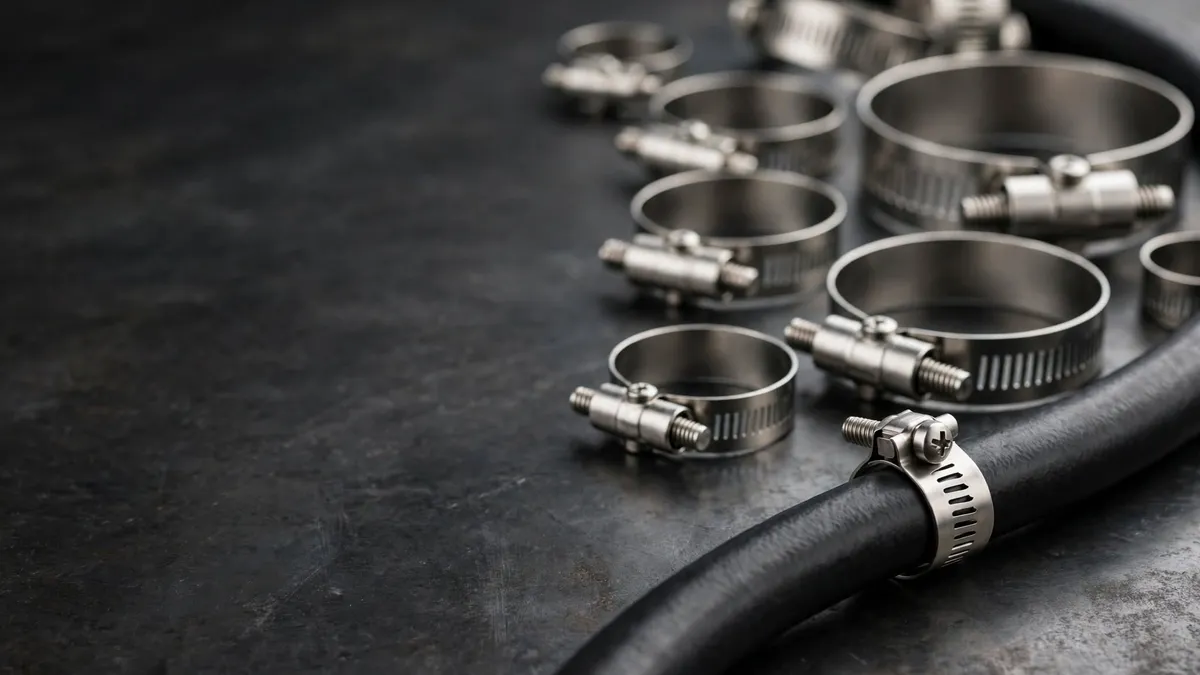
Two clamps can look exactly the same on a shelf. Same shine, same screw, same size printed on the box. Fit them both, and one may serve quietly for a long time while the other starts leaking, loosening, or showing rust marks much sooner. The difference is rarely visible. It is in the material, and in whether that material actually suits the place where you have fitted it. That is exactly why the SS 304 hose clamp deserves a closer look before you buy on price alone.
What SS 304 actually means, in simple words
SS 304 is a grade of stainless steel. In everyday language, it is the most commonly used stainless grade for general industrial work because it offers a good balance of corrosion resistance, strength, and value. When people in the trade say a clamp is W4, they generally mean that the important parts of the clamp — the band, the housing, and the screw — are made from stainless steel in the 300 series family, which includes 304. That detail matters. A clamp is not truly an SS 304 hose clamp just because the band is stainless. If the screw or housing is made from a lower material, that weaker part is usually where trouble starts first. So the first question to ask any supplier is a simple one: is every part 304, or only the band? A clear answer, supported by material documentation, tells you far more than a shiny finish ever will. Finish can be polished. Grade has to be proved.
Where an SS 304 hose clamp works really well
Think about the jobs most plants and vehicles ask a clamp to do every day. Holding a coolant hose in an engine bay. Sealing an air intake connection. Securing water lines, general utility hoses, and low to medium pressure lines in factories, workshops, farms, and commercial buildings. For these kinds of normal industrial and automotive environments, SS 304 is popular for a good reason. It handles moisture and everyday exposure far better than a plain or zinc-coated carbon steel clamp, it stays presentable, and it does not demand the higher cost of a more specialised grade when the environment does not need it. That balance is why purchase teams often standardise on 304 for general use. It is not about buying the most expensive option. It is about buying the grade that matches the job, so you are not paying for protection you will never use, and you are not saving money on a clamp that will let you down early.
SS 304 in worm drive, T-bolt, and V-band formats
Grade is only half the decision. Design is the other half. A worm drive SS 304 hose clamp is the familiar, versatile choice for most hoses. It is easy to fit with common tools, easy to adjust, and suitable for a wide range of general applications. Choose it when access is simple and the clamping load is moderate. A T-bolt clamp in stainless steel is built for a stronger, more even grip. It is the better conversation to have when the hose is larger, the pressure is higher, the joint faces vibration, or a soft hose such as silicone needs firm and even compression without damage. A V-band clamp is different again. It joins flanged connections, commonly seen in exhaust and turbo-related assemblies, and allows the joint to be opened and refitted when service is needed. Same family of material, three very different jobs. If someone quotes you only on grade and size, without asking about pressure, hose type, and vibration, the conversation is incomplete.
How to spot genuine SS 304 and avoid mislabelled stock
You do not need a laboratory on your desk, but you do need better checks than looking at the shine. Start with paperwork. Ask for a mill test certificate or material certificate for the batch, and check that the grade stated matches what you ordered. Next, look closely at the product itself. The band edges should be clean and finished in a way that will not cut into the hose. The thread engagement should feel smooth and positive, not loose or gritty. The band should not feel unusually thin or flexible for its width. Markings, where provided, should be clear and consistent. Be careful with the popular magnet test. It can give you a rough hint, but it is not proof of grade on its own, because stainless steel behaviour with a magnet can vary with how the material has been worked. Treat it as a clue, never as a certificate. At Jolly Clamps, quality is checked from raw-material verification through to final product testing, using methods such as Statistical Process Control (SPC), Failure Mode and Effects Analysis (FMEA), Poka-Yoke, and Control Plans, supported by certifications including IATF 16949, ISO 14001, and ISO 45001. You do not need to memorise those names. Just ask any supplier what checks happen before dispatch, and listen for a specific answer.
Where SS 304 is not enough
Being honest about limits builds more trust than claiming one grade does everything. SS 304 is a strong general choice, but it is not the automatic answer for every environment. For marine use, coastal installations with constant salt exposure, and applications involving chlorides or harsh chemicals, SS 316 is usually the grade to discuss. The reason buyers consider 316 for those conditions is its improved resistance to chloride-related corrosion compared with 304. That does not make 304 a poor product. It makes it a product with a defined place. If your hose carries chemicals, sits near the sea, is washed down with aggressive cleaners, or works outdoors in a coastal plant, say so clearly in your enquiry. The right supplier will talk you through grade selection instead of simply supplying the cheapest line on the quotation. And one promise no honest supplier should make is that any stainless clamp is completely rust-proof in all conditions. Stainless resists corrosion. It does not make good selection and maintenance unnecessary.
Small maintenance mistakes that shorten clamp life
Many clamp failures blamed on material actually start with fitting. Over-tightening is the most common one. Tighten too far and you can damage the hose, distort the band, or strip the screw, and the joint that felt extra secure today becomes the joint that leaks later. Under-tightening is just as risky, especially where vibration is present. Mixing materials without thought is another quiet problem. Reusing a clamp that has been stretched, bent, or corroded is rarely a saving either. Once a clamp has lost its shape, it cannot apply even pressure in the way it was designed to. A simple habit helps: when a hose is replaced, inspect the clamp as carefully as you inspect the hose. If the screw is damaged, the band is deformed, or corrosion is visible, replace the clamp with the hose. It is a small part, but it protects a much larger system.
So, should you choose SS 304?
In most general automotive, industrial, HVAC, agricultural, and utility applications, yes — an SS 304 hose clamp is a sensible, balanced starting point. Just choose it properly. Confirm that all key parts are 304, pick the design that matches pressure and hose type, check the size range against the outside diameter of your fitted hose, and be honest about the environment. If that environment includes salt, chlorides, or harsh chemicals, discuss 316 before you order. If you share your hose outside diameter, the fluid or air inside, temperature, pressure, and where the clamp will be used, the Jolly Clamps team can help you match the grade and design to the job instead of leaving it to guesswork.
Frequently Asked Questions
1. Is an SS 304 hose clamp suitable for automotive use?
Yes, for many general automotive applications such as coolant and air intake hoses, SS 304 is a commonly chosen grade. Always confirm the clamp design, size range, and torque guidance against the vehicle and hose manufacturer’s recommendation for that specific assembly.
2. What does W4 mean in a hose clamp?
W4 is a trade classification generally used when the band, housing, and screw are made from stainless steel in the 300 series family. Always confirm the exact grade with the supplier, because a classification alone is not a substitute for material documentation.
3. Is SS 304 magnetic?
It may show a slight magnetic response depending on how the material has been worked during manufacturing. Because of that, a magnet test alone cannot prove or disprove that a clamp is genuine SS 304. Ask for material certification instead.
4. Can I use an SS 304 hose clamp outdoors?
For many general outdoor uses, SS 304 is a practical choice. For coastal locations, constant salt spray, or exposure to chlorides and harsh chemicals, discuss SS 316 with your supplier before ordering.
5. Is SS 304 hose clamp rust-proof?
No clamp should honestly be described as rust-proof in all conditions. SS 304 offers good corrosion resistance for general environments, but correct grade selection, fitting, and inspection still matter.
6. Can I reuse an SS 304 hose clamp?
Only if it is undamaged, has kept its shape, the screw works smoothly, and there is no visible corrosion or deformation. If in doubt, replace it when you replace the hose. A reused, stretched clamp cannot apply even pressure reliably.
7. What is the difference between SS 304 and SS 316 hose clamps?
Both are stainless grades, but SS 316 is generally considered for marine, coastal, chloride, and harsher chemical environments because of its improved resistance to chloride-related corrosion. SS 304 is the balanced general-purpose choice for most other applications.
8. How do I verify that a clamp is genuinely SS 304?
Ask for a mill test certificate or material certificate for the batch, check the product finish, band, and thread quality, and ask the supplier what raw-material verification and final testing they carry out before dispatch.
9. Which is better, a worm drive or a T-bolt SS 304 clamp?
Neither is better in every case. A worm drive clamp is versatile and easy to fit for general use. A T-bolt clamp gives a stronger, more even grip and is usually discussed for larger hoses, higher pressure, vibration, or soft hoses. Choose by application, not by habit.
10. What details should I share to get the right SS 304 clamp?
Share the outside diameter of the hose after it is fitted on its connector, the fluid or air inside, working pressure and temperature, hose material, and the environment where it will be used. That allows the supplier to recommend both the grade and the design.
