
Most clamps that come back as wrong size were never faulty. They were simply ordered from the wrong measurement. Someone measured the hose before fitting it, or used the inside diameter, or trusted the size printed on an old hose that had softened and changed shape over time. The good news is that sizing a clamp is not complicated once you know the one rule that matters: choose the clamp by the outside diameter of the hose after it is pushed fully onto its fitting. This hose clamp size chart guide walks you through measuring correctly, reading the chart, and avoiding the small mistakes that cause leaks and returns.
Measure correctly in three simple steps
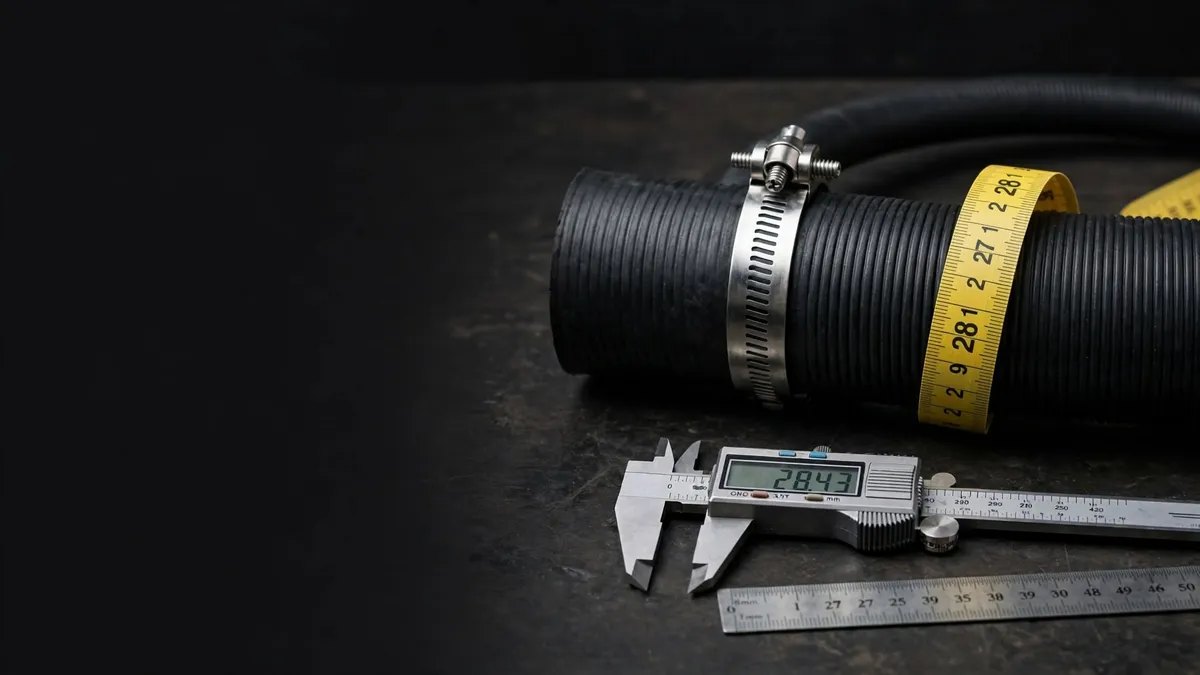
Step one, fit the hose first. Push the hose fully onto the pipe, barb, spigot, or connector it will finally sit on. A hose expands a little when it goes over a fitting, so a measurement taken on the loose hose can mislead you. Step two, measure at the clamp seat. That is the exact place where the clamp band will sit, not near the end if the hose flares there, and not over a raised part of the fitting underneath. Step three, measure the outside diameter. Wrap a flexible measuring tape around the hose and divide the circumference by pi if you need the diameter from the tape reading, or use a caliper gently across the outside without squeezing a soft hose out of shape. Take the reading twice. If both readings agree, you have a number you can trust. Now choose a clamp whose stated size range comfortably includes that outside diameter, ideally not right at the very top or very bottom of its range. A clamp working near the middle of its range will adjust more evenly and leave you room for a correct fit.
Hose clamp size chart — general reference in mm and inches
The table below is a general reference to help you understand common SAE worm drive sizes and their approximate ranges in millimetres and inches. Ranges vary by manufacturer, product line, band width, and clamp design, so always confirm the exact range on the datasheet or product page for the specific clamp you are buying before you order. Do not treat any general chart, including this one, as a substitute for that product-specific check.
| SAE size | Approx. range (mm) | Approx. range (inches) | Typical use note |
|---|---|---|---|
| 6 | 11–23 | 7/16 – 7/8 | Small hoses |
| 8 | 13–27 | 1/2 – 1-1/16 | Small to medium hoses |
| 10 | 14–27 | 9/16 – 1-1/16 | General small hoses |
| 12 | 17–32 | 11/16 – 1-1/4 | Medium hoses |
| 16 | 21–38 | 13/16 – 1-1/2 | Medium hoses |
| 20 | 21–44 | 13/16 – 1-3/4 | Larger medium hoses |
| 24 | 27–51 | 1-1/16 – 2 | Larger hoses |
| 28 | 33–57 | 1-5/16 – 2-1/4 | Larger hoses |
| 32 | 40–64 | 1-9/16 – 2-1/2 | Large hoses |
| 36 | 46–70 | 1-13/16 – 2-3/4 | Large hoses |
Reading the table is straightforward. Find your measured outside diameter in the second column, then look for a size whose range covers it with room to spare on both sides. For example, if your fitted hose measures around 30 mm across the outside, you would look at a clamp whose range includes 30 mm comfortably, rather than a clamp that only just reaches 30 mm at its absolute maximum. If your measurement falls between two common sizes, prefer the size that puts your diameter nearer the middle of its range, and confirm that advice with the clamp supplier if the hose is soft, thick-walled, or under higher pressure.
Why worm drive, T-bolt, and spring clamps size differently
It surprises many buyers that the same hose can need a different clamp range depending on the type of clamp. A worm drive clamp adjusts over a wide range and is forgiving for general work. A T-bolt clamp is built differently, with a bolt arrangement that gives a strong and even grip, and its useful range for a given nominal size is usually narrower and more specific. That is why a T-bolt size chart should always be read separately from a worm drive chart. A spring or constant-tension clamp is different again. It is designed to adjust itself as the hose expands and contracts with temperature, so its sizing is closely tied to the fitted outside diameter and the hose maker’s guidance. Soft hoses add another point. A silicone or other soft hose can be damaged by a narrow band or by uneven pressure, so a wider band or a lined design may be discussed for that application. The lesson is simple: never copy a size from one clamp type to another and assume it will behave the same. State the clamp type and the measured outside diameter together whenever you enquire.
Millimetres, inches, SAE, and DIN — the common pitfalls
Sizing confusion often comes from mixing systems. A hose may be sold by its nominal inside diameter in inches, a clamp may be listed by its adjustment range in millimetres, and a chart may refer to an SAE size number that is not a measurement at all. SAE in this context is the size designation system used on many worm drive clamp charts, including standards such as SAE J1508 for clamp types. DIN 3017 is another standard name you may see in connection with hose clamps. None of these numbers replaces your actual measurement. A hose described as one inch usually refers to its inside diameter, not the outside diameter the clamp has to go around, and the outside diameter will be larger depending on the wall thickness of that hose. Two hoses with the same inside diameter can therefore need different clamps. Round numbers can also mislead when inches are converted to millimetres and rounded. Whenever a chart, label, and measurement disagree, trust the measurement you took on the fitted hose, then match it to the specific product’s stated range. That one habit removes most sizing arguments.
Fitting, tightening, and knowing when to stop
A correctly sized clamp can still fail if it is fitted poorly. Position the band squarely on the clamp seat, over the part of the hose that is supported by the fitting underneath, not hanging over the end of the hose. Tighten steadily and evenly, and stop at the guidance given for that product. This guide deliberately does not give you a universal torque number, because the correct value depends on the clamp design, size, hose material, and fitting, and it should come from the clamp manufacturer’s datasheet and the hose manufacturer’s recommendation for your exact assembly. Over-tightening can cut into or crush a hose and damage the screw or band. Under-tightening can leave a joint that looks fine on the bench and leaks once pressure, heat, or vibration arrives. After fitting, check the joint as your system requires, look for even compression around the hose, and re-inspect after the first period of use where the application and your maintenance procedure call for it. If a joint needs repeated re-tightening to stay sealed, treat that as a sign to investigate the size, hose condition, or fitting, not as a routine.
Still leaking? Work through this short checklist
Before you blame the clamp, check five things in order. First, size: does the clamp’s range truly cover the fitted outside diameter with room to spare? Second, hose condition: is the hose cut, hardened, swollen, or damaged under the band? Third, the fitting: does the barb or spigot match the hose inside diameter, and is the hose pushed fully home? Fourth, position and tightness: is the clamp square, in the right place, and tightened to the product guidance? Fifth, application: is vibration loosening the joint, or is temperature cycling calling for a different clamp type, such as a constant-tension design? Work through the list in that order and you will find most causes without replacing parts at random. If you are still unsure, send the supplier your measured outside diameter, hose type, fitting details, and a photo of the joint. With that information, the Jolly Clamps team can help you confirm the size and type before you order again, so the next clamp fits first time.
Frequently Asked Questions
1. Do I measure the inside or outside diameter for a hose clamp?
Measure the outside diameter of the hose after it is pushed fully onto its fitting. The clamp goes around the outside of the hose, so the inside diameter alone cannot tell you the clamp size. Wall thickness means two hoses with the same inside diameter can need different clamps.
2. How do I measure a hose clamp size without a caliper?
Wrap a flexible tape around the fitted hose at the clamp seat to get the circumference, then divide that reading by pi (about 3.14) to get the outside diameter. Measure twice to check, then choose a clamp whose range covers that diameter comfortably.
3. What size hose clamp do I need if my hose is between two sizes?
Choose the clamp whose range puts your measured outside diameter nearer the middle of its range, not at either extreme. If the hose is soft, thick-walled, or under higher pressure, confirm the choice with the clamp supplier before ordering.
4. Can I use a larger hose clamp and simply tighten it down?
It is not recommended. A clamp tightened far below its intended range may not form an even circle or apply even pressure, which can lead to leaks or hose damage. Use a clamp whose stated range properly covers your measured diameter.
5. What does an SAE size mean on a hose clamp chart?
SAE size is a designation used on many worm drive clamp charts to identify a size and its corresponding adjustment range. It is not itself a diameter measurement. Always match your measured outside diameter to the actual range stated for that SAE size on the specific product.
6. Why does the same hose need a different size in a T-bolt clamp?
T-bolt clamps are constructed differently from worm drive clamps and usually have a narrower, more specific useful range for a given nominal size. Always read a T-bolt size chart separately and confirm the range for the exact product.
7. What size clamp do I need for a radiator hose?
There is no single answer, because radiator hoses vary by vehicle and hose wall thickness. Measure the outside diameter of that hose after it is fitted onto its connector, then select a clamp whose range covers that measurement, following the vehicle and hose maker’s guidance.
8. How tight should a hose clamp be?
Tighten to the guidance for that specific clamp, hose, and assembly, as given in the clamp manufacturer’s datasheet and the hose manufacturer’s recommendation. There is no safe universal torque number for all clamps. Over-tightening can damage the hose and clamp, while under-tightening can leak.
9. Why is my correctly sized hose clamp still leaking?
Check the hose condition, whether the hose is pushed fully onto a correctly matched fitting, the clamp position, whether it is tightened to guidance, and whether vibration or temperature cycling needs a different clamp type. Work through those points before replacing parts at random.
10. Should I trust the size printed on my old hose or old clamp?
Use it only as a starting hint. Old hoses can soften, swell, or change shape, and a previous clamp may itself have been the wrong size. Re-measure the outside diameter of the fitted hose and match it to the new product’s stated range.
