
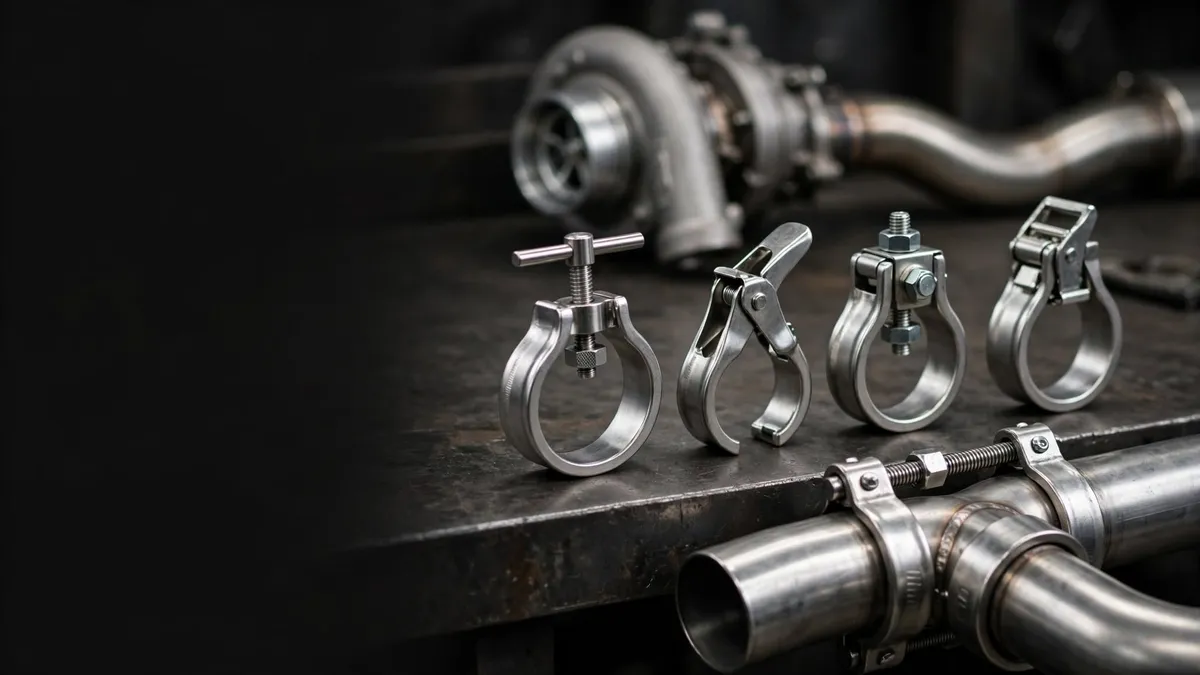
Open our V band clamp range and you will see a row of product codes: TV, QTV, DTV, AVB, VCL and VC. If you are not familiar with them, the letters can look like a puzzle. The good news is that the choice becomes simple once you know what you need from the joint.
This guide explains each type in plain language and helps you pick between them. If you are new to V band clamps.
First, Decide What the Joint Needs
Before comparing models, answer three questions:
- How often will the joint be opened? Rarely, regularly or at every service?
- What are you connecting? A general exhaust joint, a turbo or a diesel particulate filter?
- What is the working space like? Can a technician reach the closure easily, or is it tucked away?
Your answers will point you to the right family below. Remember that sizes and options differ by product, so confirm details on each product page or with our team.
V-Band Coupling Clamp (TV)
The TV is our V-band coupling clamp. It is a sound starting point for general flanged exhaust joints where you want a reliable, serviceable connection. If your needs are straightforward, this is a good first model to look at.
Saddle Type Quick Release V-Band Clamp (QTV)
The QTV is a saddle-type quick-release clamp. Quick-release designs are made for joints that technicians open and close often, because they cut down the time spent at each service point. Consider it when speed of access matters.
Allen Bolt Quick Release V-Band Clamp (AVB)
The AVB is a quick-release clamp that uses an Allen bolt. It suits designs where an Allen key is the preferred tightening tool and quick release is still wanted. Check it if your assembly or service procedure is built around Allen-bolt closures.
Diesel Particulate Filter V-Band Clamp (DTV)
The DTV is made for diesel particulate filter connections. DPF housings face heat cycles and are removed for cleaning or replacement, so a clamp designed for this role is a sensible choice. Our article on V band clamps for DPF systems explains the thinking in more detail.
V-Clamp with Connecting Link (VCL)
The VCL is a V-clamp built with a connecting link. Because designs like this can suit particular assemblies, share your drawing with our team and we will confirm whether the VCL fits your joint.
V-Clamp (VC)
The VC is the straightforward V-clamp in our range, for flanged joints that need a strong and simple clamping solution.
Quick Selection Guide
| If you need… | Look at |
|---|---|
| A dependable clamp for a general flanged exhaust joint | TV or VC |
| Fast access at a joint that is opened often | QTV |
| Quick release with an Allen bolt closure | AVB |
| A clamp for a diesel particulate filter connection | DTV |
| A design that uses a connecting link | VCL |
| Something outside the standard range | Custom clamp |
Treat this as a starting point, not a final answer. The flange profile, size, temperature and material still need to be checked against the clamp you select.
What If None of These Fits?
Sometimes a standard clamp is not the answer. Your flange may be unusual, or your assembly may have tight space limits. In those cases, we design customised clamps to your requirements. Send us the drawing and tell us about the application.
Why Buyers Choose to Work With Us
Jolly Clamps has been supplying engineered clamping solutions for over five decades. Our manufacturing runs under IATF 16949, ISO 14001 and ISO 45001 certifications, with quality methods like SPC, FMEA, Poka-Yoke and control plans.
Bolt, Quick-Release or Allen Bolt: Choosing a Closure
The closure is the part of the clamp you actually touch, so it is worth thinking about. A standard bolt closure is simple and familiar. A quick-release closure saves time at joints that are opened often. An Allen bolt closure suits assemblies where an Allen key is the tool of choice. None is better in every case. The best one depends on how the joint is used and who will be servicing it.
Three Example Selections
These examples show the thinking. They are not substitutes for checking your own drawing.
- A genset builder with a joint that rarely moves: A straightforward clamp such as the TV or VC is a reasonable starting point.
- A fleet workshop that removes the same joint regularly: A quick-release option such as the QTV is worth looking at, as it reduces handling time.
- An OEM adding a particulate filter to a new engine: The DTV is made for that connection, so it is the natural place to begin.
Basics That Apply to Every Type
Whichever clamp you pick, some good habits stay the same:
- Match the clamp to the flange profile and size, not the pipe diameter alone.
- Keep the flange faces clean and undamaged.
- Align the parts before tightening, and do not use the clamp to pull them into line.
- Tighten to the value set by your engine or machine manufacturer.
- Inspect the clamp at service and replace it if it is cracked, distorted or badly corroded.
Common Mistakes When Choosing a Type
- Selecting by the product code alone, without checking the flange details
- Choosing a quick-release style for convenience without checking vibration and operating conditions
- Ignoring the material grade and surface environment
- Leaving the choice until after the design is frozen, when changes are costly
How Our Team Helps You Decide
You do not have to work this out alone. When you send us your enquiry, our engineers look at the flange drawing or sample, the application and the way the joint will be serviced. From there, we suggest a standard clamp from the range or, where needed, a customised design. Along the way, we will tell you honestly if a different type suits your joint better than the one you had in mind.
To make this quick, send the following in your first message: a flange drawing or sample, the application, the preferred material if you have one, and the quantity you need. That is enough for us to get started.
Final Thoughts
Choosing among TV, QTV, AVB, DTV, VCL and VC comes down to how the joint is used: how often it opens, what it connects and how easy it is to reach. Match those needs to the right type, confirm the flange details and you are most of the way there.
Frequently Asked Questions
1. What do the codes TV, QTV, AVB, DTV, VCL and VC mean?
They are the model codes in our V band clamp range: V-Band Coupling Clamp (TV), Saddle Type Quick Release (QTV), Allen Bolt Quick Release (AVB), Diesel Particulate Filter clamp (DTV), V-Clamp with Connecting Link (VCL) and V-Clamp (VC).
2. Which V band clamp is best for a general exhaust joint?
The TV or VC is a good place to start for general flanged exhaust joints. Confirm the flange profile, size and material against your application.
3. What is a quick-release V band clamp?
It is a V band clamp with a closure designed for fast opening and closing. It is useful where a joint is opened often, such as during regular servicing.
4. When should I choose an Allen bolt V band clamp?
Choose it when your assembly or service procedure uses an Allen key and you want quick release. Check the product page for details and options.
5. Which clamp should I use for a diesel particulate filter?
The DTV is made for DPF connections. Confirm the flange details and operating conditions with our team before finalising.
6. What is the VCL clamp?
The VCL is a V-clamp built with a connecting link. Share your drawing with us and we will confirm whether it suits your joint.
7. How do I know the right size of V band clamp?
Size depends on the flange, so measure the flange outer diameter, profile and thickness, or send a drawing or sample. We will confirm the right fit.
8. Can I use a quick-release clamp on every joint?
Not necessarily. Choose the closure based on how often the joint is opened, vibration levels and access, and confirm it suits your operating conditions.
9. Does Jolly Clamps offer custom V band clamps?
Yes. If none of the standard models fits, we can design a customised clamp to your requirements.
10. How do I get a quote for V band clamps?
Use the Get a Quote option or contact page on our website, and share your flange drawing, application and quantity so we can respond accurately.
