
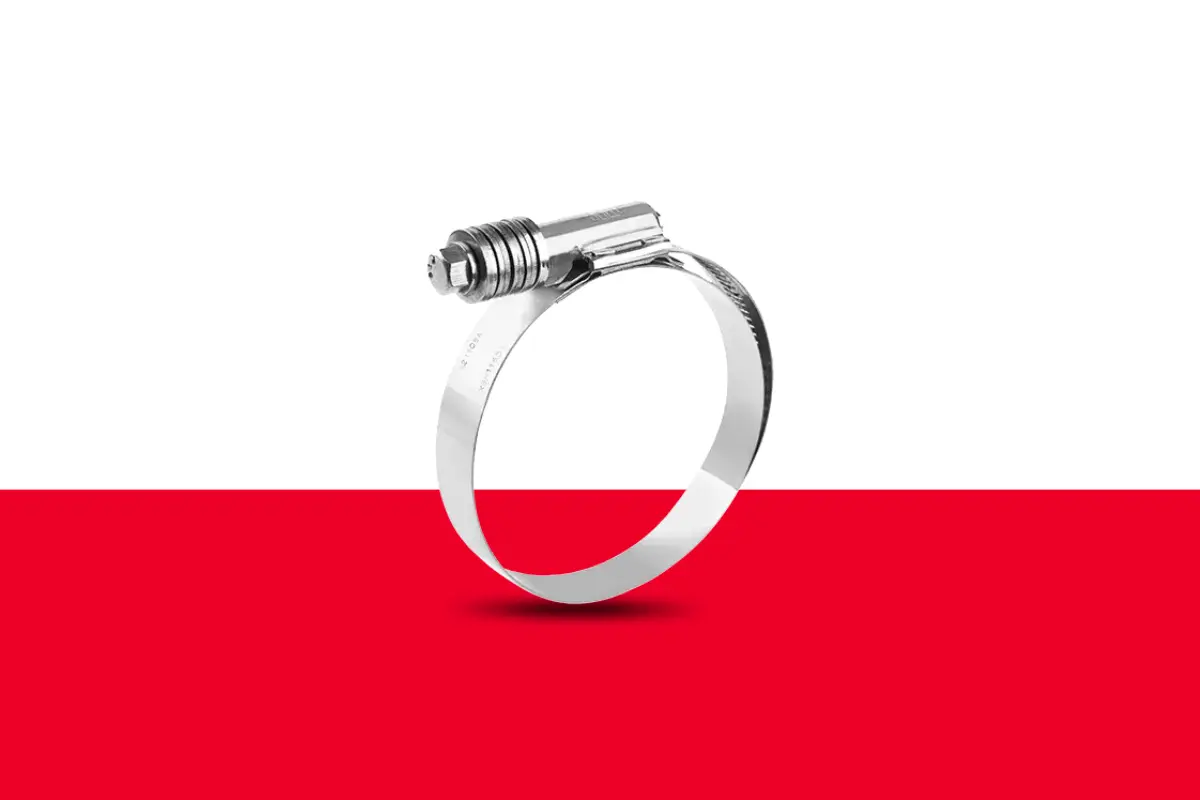
Road salt doesn’t destroy your hose. It destroys the clamp holding it.
That distinction matters because most fleet operators, OEMs, and plant managers troubleshoot in the wrong order. They replace hoses. They check fittings. They miss the clamp—now weakened, pitted, and no longer holding the seal it was specified to have.
In northern Europe, this plays out thousands of times every winter. Sodium chloride hits the road. Chloride ions penetrate the metal surface of standard clamps. Pitting starts. Crevice corrosion follows. Meanwhile, the temperature swings from -15°C overnight to 90°C+ in an engine bay — and the hose expands, contracts, and relaxes. A fixed-torque clamp can’t follow that movement. The clamping force drops. The seal weakens. The leak begins.
By that point, the clamp itself cost less than €2. The downtime it causes can run to several thousand.
Why Standard Clamps Fail in Salted Conditions
The problem is two separate failure modes happening simultaneously — and most clamps are only designed to handle one.
The first is corrosion. W2 and W3 grade clamps (carbon steel, zinc-plated) start showing visible rust within hours in ASTM B117 salt spray testing. W4 / SS304 holds up longer but remains vulnerable in high-chloride environments – coastal exposure, de-iced roads, and marine applications. The molybdenum content in W5 / SS316 (2–3%) is what changes the equation. It blocks chloride ions from initiating pitting at the surface, maintaining structural integrity where 304 starts to fail.
The second failure mode is hose cold flow. Rubber and silicone hoses relax under sustained load — and they do it faster when thermal cycling is involved. Cold starts, hot engine bays, cold nights again. A standard worm drive clamp, installed to the correct torque, loses effective clamping pressure over time as the hose material moves under it. No mechanism compensates. The clamp just sits there, technically “tight”, functionally loose.
These two problems together — chloride attack on the clamp and thermal relaxation of the hose — are what cause failures in heavy trucks, gensets, and off-highway equipment operating through northern European winters.
What Constant Tension Changes
Jolly’s HDCTWD (Heavy Duty Constant Tension Worm Drive) clamps carry a built-in spring mechanism that automatically compensates for hose diameter changes. As the hose expands or contracts with temperature, the clamp follows it. Clamping force stays consistent — not as a function of periodic re-tightening, but continuously, by design.
The practical effect in winter conditions:
Cold starts don’t produce temporary leaks. The seal holds through the pressure spike. Vibration on salted, potholed roads doesn’t walk the clamp loose over time. And maintenance intervals stretch — fewer inspections, fewer adjustments, less labour.
For lined variants (WTL series), an internal liner protects soft hose surfaces from band edge damage while improving the quality of the seal contact. This matters most on silicone hoses, where a bare band edge can cause surface damage that becomes a leak path of its own.
The Material Spec: W5 / SS316 for European Export
Jolly HDCTWD is available across multiple material grades. For European winter environments — Germany, Poland, Scandinavia, and any market where road salt is heavy and operating conditions are aggressive — W5 / AISI 316 is the specification to use.
The difference between W4 and W5 is not marketing. In salt spray testing, 316 maintains surface integrity significantly longer than 304 under equivalent chloride exposure. In practice, that means clamps that don’t need replacing every season and systems that don’t leak because the clamp corroded before the hose did.
Jolly HDCTWD in W5 is compliant with relevant SAE and DIN standards, RoHS compliant, and available with full material traceability for OEM documentation requirements. Our facility in Mumbai has been manufacturing and exporting clamping solutions for over 55 years, with an established supply chain serving European OEMs and distributors directly.
Where These Clamps Are Used
HDCTWD in SS316 is specified across automotive cooling, turbo, and charge air systems — particularly relevant under Euro 7 durability requirements — as well as commercial vehicle and heavy truck applications; gensets and standby power; HVAC fluid lines in outdoor industrial installations; and marine and off-highway equipment.
If the application involves thermal cycling, vibration, and any degree of chloride exposure, this is the clamp to specify.
Specifying the Right Clamp
For new builds or replacement programmes, the selection logic is straightforward: if the operating environment includes salted roads, coastal exposure, or marine proximity, specify W5. If the hose is silicone or soft rubber, add the lined WTL variant to protect the hose surface. Follow installation torque guidelines on the first fit—after that, the constant-tension mechanism manages the rest.
For custom diameter ranges, banded configurations, or private label requirements, our export team works directly with European partners on specification and sampling.
Ready to run a sample evaluation?
Contact our export team for material certification sheets, salt spray test data, and samples dispatched within 5 working days. Visit jollyclamps.com or email sales@jollyclamps.com — reference HDCTWD-EU for direct handling by our export team.
