
When the North Sea turns rough, German ships don’t fight it. They come ashore.
From November through February, vessels that spent the warmer months hauling cargo, servicing offshore wind farms, or running Ro-Pax routes pull into dry docks in Hamburg, Kiel, and Bremerhaven. This isn’t downtime — it’s Werftzeit. Planned. Structured. And for us at Jolly Clamps, it’s one of the most predictable procurement windows we work around every year.
In this article, we break down what actually happens inside German shipyards each winter, where the real clamp volume sits, and what buyers require from a marine hose clamp supplier before you make it onto an approved list.
The Cut-and-Replace Rule: Why Clamps Disappear Every Winter
Here’s something that surprises people outside the industry: salt-corroded clamps on exposed systems aren’t inspected, retightened, or reused. They’re cut off and thrown away.
This is standard practice – not caution, just engineering reality. In a saline environment, a marine-grade hose clamp that looks fine on the outside can be compromised underneath. German marine engineers don’t take that risk. The rule is simple: if it was on a critical line and spent time at sea, it goes in the bin.
The numbers follow from that rule. A mid-size cargo vessel or Ro-Pax ferry goes through 1,200 to 2,300 stainless steel hose clamps in a single major refit. Larger ships push that higher. A major yard processing 40 to 60 vessels in one winter season works through tens of thousands of clamps — and that’s before you factor in the green retrofit wave sweeping European fleets right now.
EU emissions compliance is driving scrubber installations, ballast water treatment upgrades, and alternative fuel conversions across ageing fleets. Every upgrade means new corrosion-resistant piping. Every metre of new piping means clamps.
We see this demand clearly in our own order patterns, and 2026 is shaping up to be the strongest Werftzeit window in several years.
Where Each Clamp Type Lives on a Vessel
We hear this often: “A hose clamp is a hose clamp.” On a commercial vessel, that’s exactly the wrong way to think about it. The application drives the specification, and the specification drives the grade — and getting it wrong means a failed survey or a system failure at sea.
Here’s how we map our range to the key systems on board:
Ballast water, raw seawater cooling, and wet exhaust run on W5 hose clamps – 316 stainless steel with molybdenum. Saline environments cause pitting corrosion that SS304 cannot resist. Our heavy duty T-bolt hose clamps and constant-tension hose clamps are the standard choice here. A constant-torque hose clamp handles the pressure cycling that fixed-torque fasteners can’t manage – critical on systems that heat up and cool down with every run.
HVAC, fresh water, sanitary, and pneumatic lines are higher volume and slightly less demanding—W4 hose clamps (SS304) or W5, depending on the yard’s spec sheet. HVAC hose clamp and high-pressure hose clamp applications in this zone are typically where chandlers qualify us as a second source first. Lower risk to start, still serious volume.
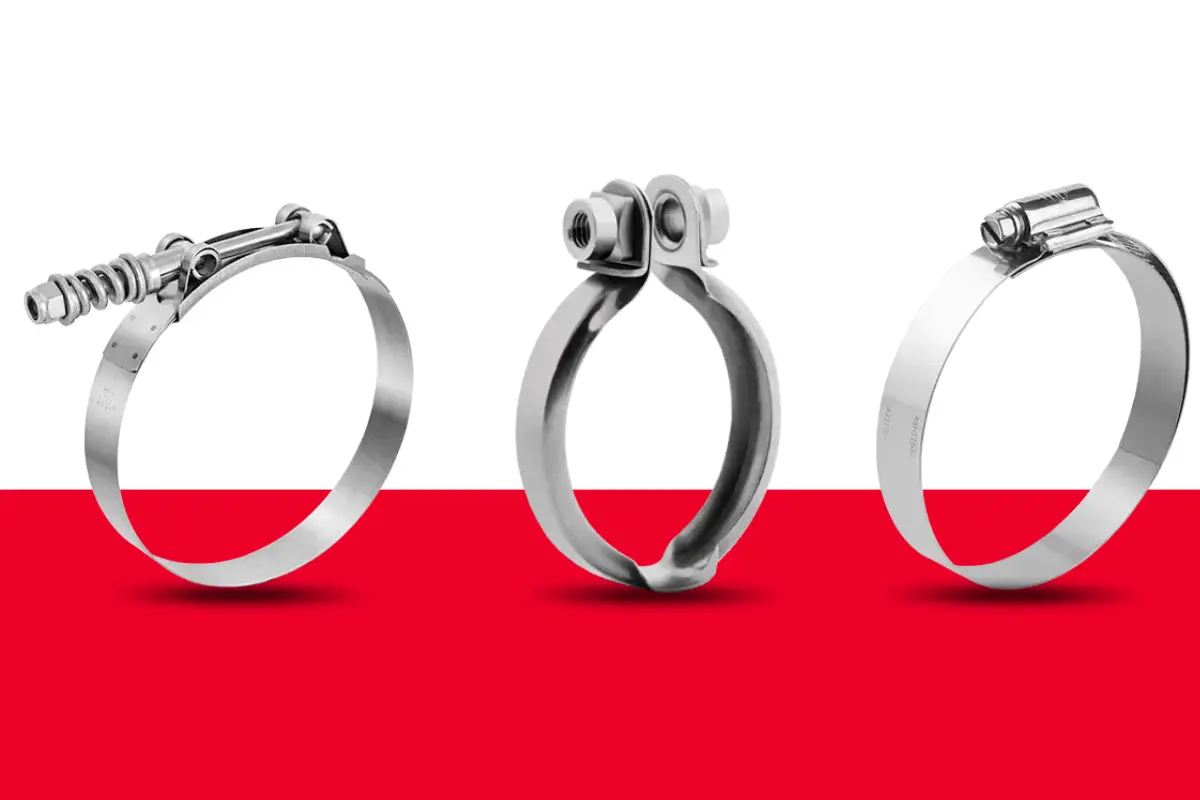
Exhaust, scrubbers, and turbo connections use our stainless steel V-band clamps – ‘V-Band Schellen’ in German procurement language. Quick-release designs are preferred where service access matters. The exhaust V-band clamp is a refit staple on any vessel with wet exhaust systems.
Silicone hose connections and charge air lines in the engine room use worm-drive formats – our DIN 3017 hose clamp range, which is the default specification German buyers reach for in this category. Silicone hose clamps and charge air hose clamps here are high-frequency replacements across a refit.
What German Marine Buyers Actually Require From Us
German procurement culture is sachlich — matter-of-fact and specification-driven, with no patience for brochure language. When a ship chandler (Schiffsausrüster) evaluates us as a Schlauchschellen Lieferant, they aren’t weighing our story. They’re checking a list.
The list we’re prepared for: DIN 3017 compliance for worm-drive clamps. EN 10204 3.1 mill certificates covering full material traceability. ASTM B117 salt-spray test results. PMI verification on our Edelstahl Schlauchschelle stock. REACH and RoHS compliance.
The ‘Schlauchschelle Edelstahl V4A‘ designation — ‘SS316’ in German spec language — appears on approved material lists for safety-critical marine systems. We supply it, we document it, and we can prove it before the conversation goes further.
Our processes are aligned to IATF 16949-level quality, which means traceability from raw coil to finished clamp. We’ve run this way for over 55 years. Not because a customer asked for it — because it’s the only way to manufacture components that go on vessels.
The Displacement Opportunity: Why “Norma Alternative” Is a Real Search
Norma (Normaclamp TORRO for worm-drive, COBRA for constant tension) and Mikalor (SUPRA, SUPRA CT) dominate European marine supply. ABA holds positions in specific segments. These brands have been on vessels for decades, and nobody replaces them overnight on safety-critical systems — nor should they.
But supply chain diversification is now a real priority for chandlers who ran single-source procurement for years. They’re actively searching for a qualified Norma hose clamp alternative or Mikalor clamp alternative — not to remove their primary brand, but to protect continuity when lead times slip or pricing spikes.
That’s where we position ourselves: a qualified second source with full documentation. We typically start on HVAC hose clamps, sanitary lines, and fresh water systems where the qualification risk is lower. After one or two Werftzeit cycles of consistent delivery, the conversation naturally expands to W5 applications.
Buyers searching for an ABA clamp alternative or Norma Schellen alternative are the highest-intent prospects in this market. They’ve already decided something needs to change. We want to be the first supplier they find — with the right spec sheet ready.
What We Offer
Our marine range covers worm drive hose clamps, heavy-duty constant tension clamps, stainless steel V-band clamps, and T-bolt hose clamps in both W4 and W5 grades. Every product ships with full material traceability and the certifications German marine buyers require.
We also work as an OEM hose clamp manufacturer and private label hose clamp supplier — so chandlers and wholesalers who need stock under their own brand get the same manufacturing quality with their name on it.
We support ETIM and BMEcat data formats for distributors running structured procurement systems. IMPA codes are mapped across our full marine catalogue.
As a hose clamp manufacturer and exporter based in India, we have over 55 years of export experience behind us. That translates into reliable lead times, stable pricing, and the ability to meet the August–October stocking window that Werftzeit procurement runs on. We’re zero-debt and owner-operated, and we’ve been exporting to Europe long enough to know what “on time” means to a chandler with a dry dock schedule.
Let’s Talk Before the Window Closes
Pre-winter stocking decisions in Germany happen between August and October. That’s the window — and it moves faster than it looks.
We provide DIN 3017 hose clamp datasheets, EN 10204 3.1 mil certificates, IMPA code mappings, and ETIM/BMEcat files on request. Samples are available for qualification across our full marine range.
Reach us at sales@jollyclamps.com or via jollyclamps.com/contact.
