
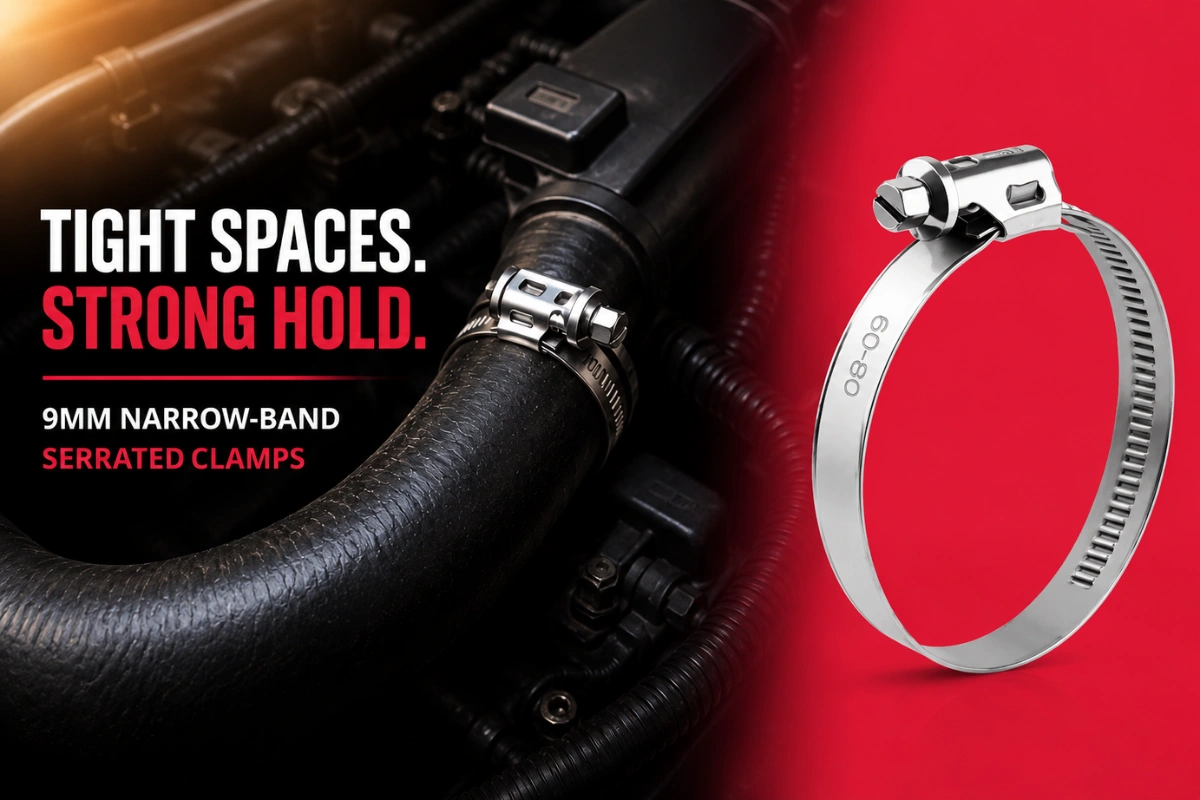
Walk through the engine bay of almost any new European passenger car or light commercial vehicle launched in the last two years and you will notice something immediately: there is almost no empty space left.
Hoses that once had generous clearance now run between EGR coolers, gasoline particulate filters (GPF), larger AdBlue injectors, variable-geometry turbo actuators, and complex crash structures designed for pedestrian protection. Add the push for lower vehicle weight and better aerodynamics, and the available real estate for even small-diameter vacuum, breather, fuel-return, and auxiliary coolant lines shrinks dramatically.
Euro 7 type-approval requirements for new light-duty vehicles begin 29 November 2026, with full registration compliance from late 2027. While the regulation focuses on tailpipe emissions and durability, the practical engineering consequence is more aftertreatment hardware packed into the same or smaller footprint. The result is a generation of engine bays where a standard 12 mm or wider band clamp can physically interfere with wiring looms, brackets, or adjacent hoses or simply cannot seat properly on the small-diameter lines now common in these applications.
Where Conventional Wider Clamps Struggle
In tight packaging, wider-band worm-drive clamps create several real problems.
Interference and installation difficulty come first. The extra band width leaves little room to maneuver a screwdriver or socket without risking damage to nearby components. European assembly plants and aftermarket technicians report increased labour time on these connections.
Then there is uneven pressure on small hoses. Many vacuum, breather, and actuator hoses in modern engines have outside diameters between 8 and 16 mm. A wider band can bridge or deform the hose wall instead of applying consistent 360° compression.
Vibration and thermal loosening risk follow from that. Engine bays experience constant vibration plus wide temperature swings, especially near turbos and EGR circuits. If the clamp cannot seat fully or evenly, micro-movement accelerates wear and eventual leakage.
Finally, the cost multiplier in Europe is real. Labour rates for both OEM assembly and dealer service remain high. A clamp that adds minutes per vehicle or leads to warranty claims quickly becomes expensive.
These are not theoretical issues. European aftermarket suppliers have long offered 9 mm band versions of popular worm-drive clamps precisely because narrow-band designs fit where wider ones do not.
Why 9mm Narrow-Band and Two-Way Serrated Changes the Equation
A true 9 mm bandwidth clamp occupies significantly less radial and axial space. It can sit completely within the available clearance, reducing the chance of contact with other components. On small-diameter hoses it conforms more naturally, delivering more uniform radial force without the “bridging” effect sometimes seen with wider bands.
Combine narrow band width with formed-thread worm-drive construction and two-way serrated band design, and the performance gains become even more relevant for European applications.
Formed thread construction (non-perforated) creates clean, consistent engagement with the housing. There are no stamped burrs or sharp edges that can score the band or create stress risers. Torque application feels positive and repeatable, which matters when technicians are working in confined spaces with limited visibility.
A two-way serrated band places engagement features on both surfaces of the band. This improves circular grip, reduces the chance of the band slipping under load or vibration, and helps prevent seepage on harder or reinforced hoses common in automotive systems.
Material grades matter in Europe as well. Road salt, underbody moisture, and temperature cycling demand proper stainless steel. W4 (AISI 304) offers excellent general corrosion resistance; W5 (AISI 316) adds molybdenum for superior performance in marine or highly corrosive environments.
Jolly Clamps’ Two-Way Serrated (FD) series is built exactly to this specification: DIN 3017-01 compliant, formed-thread worm drive, two-way serrated for secure grip, and available in the stainless grades European OEMs and Tier-1 suppliers expect.
Practical Guidance for European Design and Procurement Teams
When specifying clamps for new platforms or aftermarket programmes targeting Europe, a few principles hold consistently.
Map actual clearance around every small-diameter hose connection early in the packaging phase. Prefer a 9 mm bandwidth where space is under roughly 25 to 30 mm total envelope. Choose formed-thread and two-way serrated construction for harder hoses or higher mechanical-load locations. Match material grade to the environment: W4 for most under-bonnet applications and W5 where road salt or chemical exposure is severe. Consider constant-torque or constant-tension variants for any connection subject to wide temperature swings. And validate installation torque and tool access in representative prototype builds, because what looks possible on a CAD model can be surprisingly difficult on the line.
The Bottom Line for 2026 and Beyond
European engine-bay packaging is not going to get easier. Emissions durability requirements, weight targets, and crash regulations will continue to push components closer together. The clamps that succeed in this environment are not necessarily the strongest or the widest. They are the ones that fit properly, grip consistently, and stay tight without requiring heroic installation efforts or expensive redesigns.
9 mm narrow-band serrated clamps with formed-thread construction give engineers and technicians a practical, proven tool for exactly these conditions. Jolly Clamps has been manufacturing these solutions for decades and supplies them to OEMs and distributors who value both technical performance and long-term reliability.
Ready to evaluate 9mm serrated or constant-torque options for your next European application? Contact our technical team for samples, dimensional drawings, or a clamp selection review tailored to your hose diameters and packaging constraints.
Need 9mm or custom narrow-band clamps for a European platform? Request samples or a technical consultation.
