
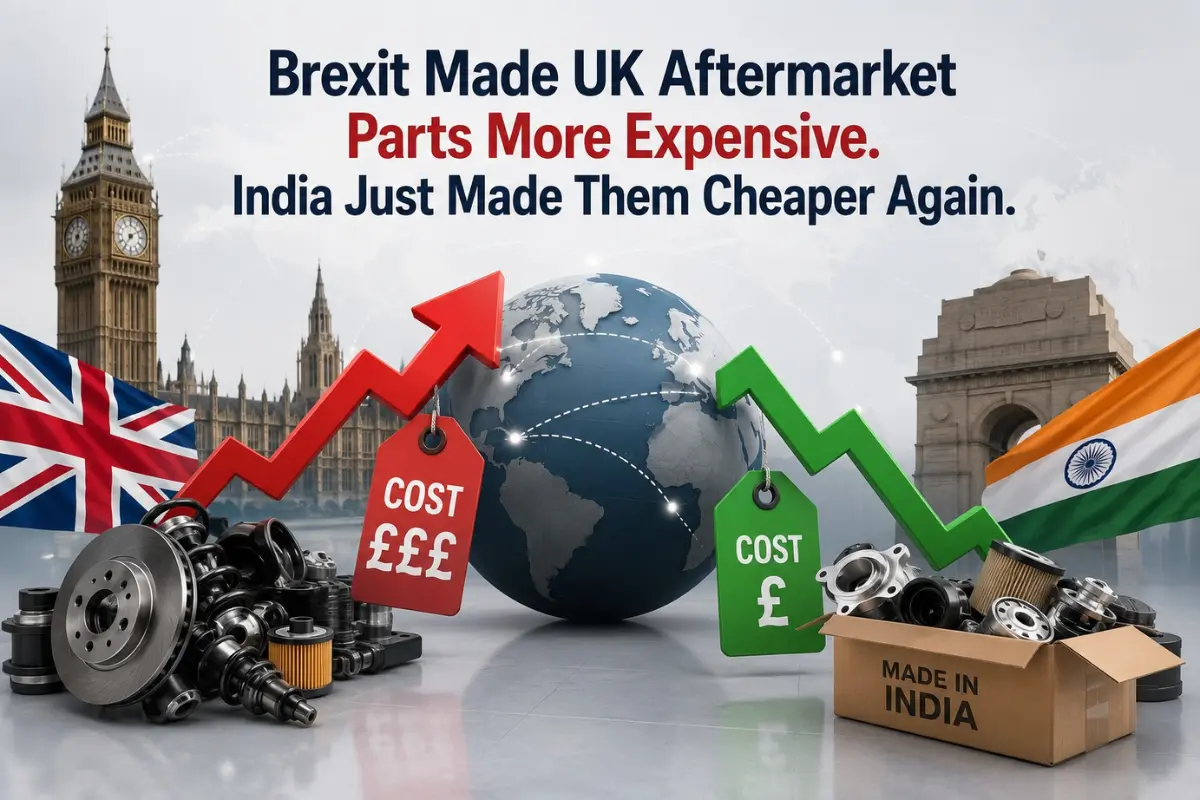
Walk into almost any independent garage in the Midlands or a busy fleet workshop outside Manchester and you will hear the same quiet frustration. Parts that used to arrive in three days now take ten. The invoice is higher than expected. The explanation is always some version of “Brexit paperwork and logistics.”
That friction did not disappear after the Trade and Cooperation Agreement. It simply became the new normal. Customs declarations, rules-of-origin checks, temporary storage charges and the extra administrative load all pushed the landed cost of many aftermarket components upward. For workshops and fleets running mixed European vehicles, the effect was especially noticeable on the smaller, high-volume items that keep vehicles on the road: hose clamps, couplings, brackets, and the everyday fasteners that rarely make headlines but stop work when they fail.
Then, on 15 July 2026, something shifted.
The India-UK Comprehensive Economic and Trade Agreement (CETA) entered into force. Almost 99% of Indian goods now enter the UK either duty-free or at substantially reduced tariffs, and automotive components sit firmly inside that preferential treatment. For UK buyers, and for the wider European aftermarket that sources through UK distributors, a major cost-competitive supply base just got a lot more accessible.
What Actually Happened to Aftermarket Prices After Brexit
The post-Brexit cost increase was never only about tariffs. In most cases, formal duties between the UK and EU stayed at zero under the TCA, so long as the goods could prove they qualified as originating there. The real expense came from non-tariff barriers: longer border processing times, the need for more detailed commercial documentation, the cost of compliance systems, and the simple reality that every extra day of inventory sitting in a bonded warehouse has a price.
Industry reporting from 2022 onward has consistently pointed to longer lead times and higher landed costs for parts moving between the UK and the Continent. Independent garages and smaller distributors felt it first. Larger fleets absorbed some of the increase and passed the rest downstream. By 2025 the pattern was clear enough that many operators had started looking harder at non-EU sources that could deliver consistent quality without the same friction.
Clamps and related fastening products sit in an interesting position inside this story. They are rarely the most expensive line on an invoice, yet a single failed clamp can take a vehicle off the road. European engine bays have grown tighter and hotter. Exhaust after-treatment systems, constant-torque requirements for fluctuating temperatures, and more aggressive road-salt exposure in northern Europe have all raised the performance bar. Workshops cannot simply buy the cheapest option; they need parts that hold under real conditions.
India’s Long-Standing Cost Advantage Meets a New Trade Reality
Indian manufacturers have supplied European and UK aftermarket channels for years. The cost base has always been attractive: competitive steel pricing, experienced manufacturing clusters, and scale that keeps unit prices low. What changed on 15 July was the removal of residual tariffs and administrative friction specifically on the UK route.
On the first day CETA took effect, India dispatched more than $140 million in zero-duty exports from over 50 consignments across ports, airports and inland depots nationwide, spanning engineering goods, electronics, pharmaceuticals and textiles. Automotive components are named explicitly in the agreement’s covered sectors, and Indian industry chambers, including ACMA, PHDCCI and ASSOCHAM, have all pointed to the deal as a meaningful step up in competitiveness for exporters, particularly the small and medium manufacturers that make up much of the component sector and have historically faced the steepest barriers to entering developed markets.
For UK buyers, the practical effect is straightforward. A UK-based distributor or fleet can now source high-specification clamps and related hardware from established Indian manufacturers at prices that once again undercut many traditional European or UK-sourced alternatives without sacrificing the technical performance required for modern vehicles.
One caveat worth flagging: this duty advantage is specific to UK-bound trade. Buyers in Germany, the Netherlands or Scandinavia sourcing directly from India do not yet have the same tariff relief since CETA is a bilateral UK-India agreement. A separate EU-India trade deal concluded negotiations in January 2026 and is moving through ratification, which would open a comparable route into the wider European market once it takes effect. Until then, the buyers best placed to feel the immediate benefit are UK distributors themselves and the European workshops that source through them.
Why Clamps Matter More Than Most People Realise
A hose clamp looks simple until it fails. In a modern European commercial vehicle, the cooling system, turbocharger, EGR circuit and after-treatment lines all depend on reliable sealing under vibration, thermal cycling and chemical exposure. Constant-torque designs compensate for hose expansion and contraction. Serrated bands improve grip on harder compounds. Stainless grades, particularly 316 in coastal or winter-salt environments, resist the corrosion that can degrade an ordinary mild-steel clamp within a season or two.
When supply-chain friction raises the price of these components, workshops face a quiet dilemma. They can absorb the cost, pass it to the customer, or look for alternative sources that still meet the required standards. CETA has made that third option considerably more attractive.
What UK and European Buyers Should Look For
Not every Indian clamp supplier is equal. Independent garages, national fleets and industrial maintenance teams all need suppliers who can demonstrate more than a low unit price. The practical checklist experienced buyers now use includes:
- Material grade verification and traceability, ideally against DIN or EN reference standards
- Corrosion performance data, such as salt-spray hours
- Fatigue and constant-torque testing results
- Consistent dimensional control across large batches
- Ability to supply both standard ranges and application-specific variants
- Documented export experience into Europe and the UK, including current certifications (IATF 16949 and ISO 9001)
Suppliers that already maintain export relationships in Europe tend to move faster on documentation and after-sales support. They also understand the difference between a part that merely fits and a part that keeps performing after 100,000 km of real-world use.
How the Opportunity Looks on the Ground
Consider a typical UK fleet operator running a mixed diesel and increasingly hybrid light-commercial fleet. Winter salt, stop-start urban cycles and higher under-bonnet temperatures have shortened the service life of ordinary worm-drive clamps. Switching to properly specified constant-torque or stainless designs reduces roadside failures, and under the new trade terms, those higher-specification parts can now be sourced from India at landed costs that were difficult to justify twelve months ago.
This is exactly the space Jolly Clamps has worked in since 1968. As a Mumbai-based, IATF 16949 and ISO 9001 certified manufacturer of worm drive (SSWD, HDCTWD, SIWD), T-bolt, V-band and No-Hub couplings built to DIN 3017 and equivalent EN specifications, Jolly Clamps is one of the suppliers positioned to fill exactly this gap: DIN-standard hardware, at CETA-advantaged cost, backed by decades of export experience into European and North American markets.
Practical Next Steps for UK and European Aftermarket Buyers
- Audit the current landed cost of your highest-volume clamp and coupling lines, including any Brexit-related admin or delay costs you currently absorb.
- Request updated pricing and lead-time data from Indian manufacturers that already export into Europe, and ask specifically about CETA preferential origin documentation.
- Compare technical data sheets, not just price. Look for salt-spray results, torque-retention curves and material certificates.
- Start with a controlled trial on one vehicle type or application before rolling out more widely.
- Confirm packaging, labelling and documentation standards match your warehouse and compliance requirements.
The window created by the new agreement will not stay this wide open indefinitely. Other trade arrangements and currency movements will keep shifting the competitive landscape. Buyers who move while the preferential access is fresh stand to lock in both cost and supply advantages.
The Bottom Line for UK and European Buyers
Brexit raised the real cost of many aftermarket parts moving into the UK, mostly through friction rather than tariffs. CETA, now in force, removes a meaningful share of that friction for Indian-origin components. For operators who need reliable, high-performance clamps and related hardware, the arithmetic has shifted again, this time in a favorable direction.
Quality still matters more than ever. The manufacturers who already serve European customers, who test to recognized standards, and who understand the difference between a catalog part and a field-proven solution will capture the most value from this shift.
If your current clamp and coupling supply still carries the hidden costs of the last six years, it is worth running the numbers under the new trade terms. The difference is no longer theoretical.
