
By Jolly Clamps Team | Last updated: October 2026
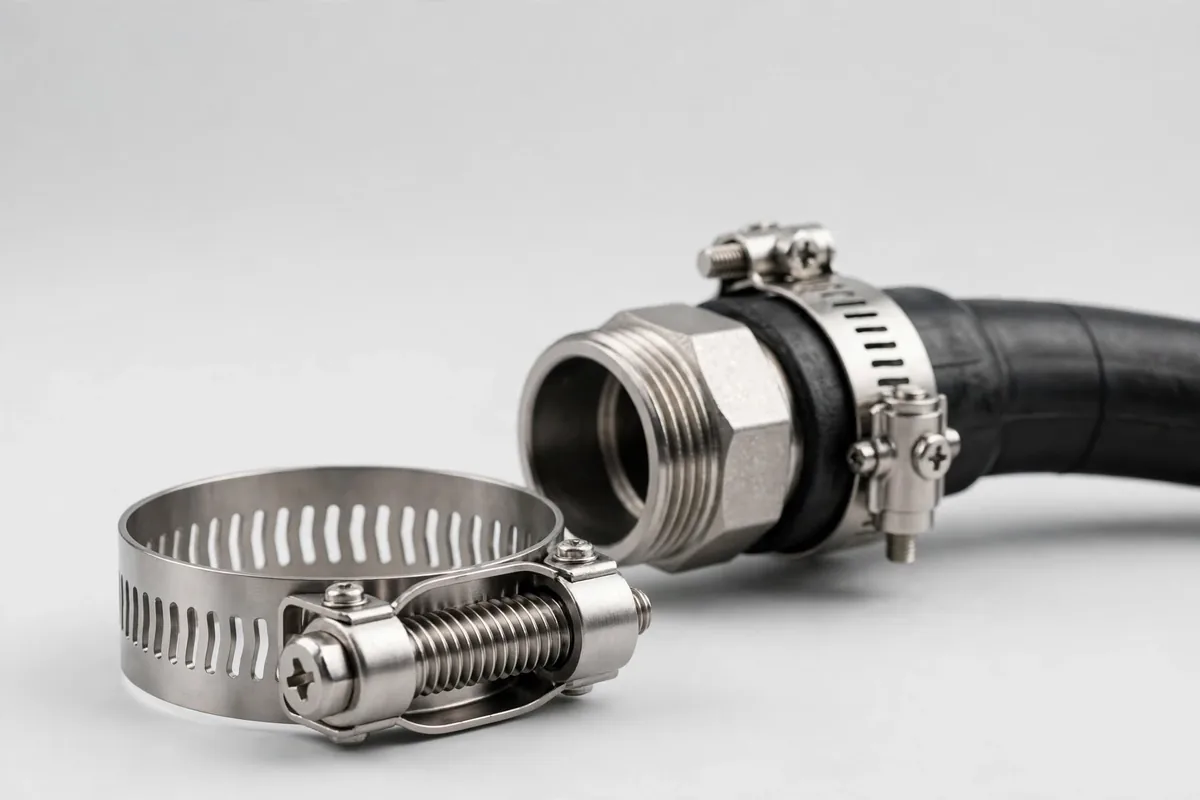
A worm gear hose clamp is a metal band with a screw built into it. Turn the screw and the band tightens around a hose, holding it firmly on a pipe, nozzle or fitting. You’ll also hear it called a worm drive clamp, and it’s probably the most common hose clamp in the world.
It looks like the simplest part on any machine, and that’s exactly why people get careless with it. The wrong size, the wrong material or the wrong band style is one of the easiest ways to end up with a leaking connection.
So here’s what we’d tell any buyer, maintenance team or distributor who asked us: how these clamps work, the main types, how to pick a stainless steel grade, and the mistakes we see again and again.
How Does a Worm Gear Hose Clamp Work?
Three parts do all the work. The band wraps around the hose. The housing sits at one end of the band and holds the screw. The screw (the “worm”) meshes with slots or threads cut into the band.
When you turn the screw, it pulls the band through the housing. The loop gets smaller, and the clamp squeezes the hose against the fitting underneath.
The best thing about this design is how adjustable it is. One clamp covers a range of hose diameters, and all you need to tighten or loosen it is a basic screwdriver or nut driver. That’s why you’ll find these clamps on everything from vehicles and irrigation lines to HVAC systems and industrial equipment.
Main Types of Worm Gear Hose Clamps
Every worm gear clamp is built the different way. These are the variations you’ll run into most often.
Perforated and Non-Perforated Bands
On a perforated band, the slots run right through the metal. On a non-perforated (solid) band, the surface is smooth and the screw engages through a different arrangement. A smooth band is often the better pick for softer hoses, since there are no edges pressing into the rubber. If your hose is thin or delicate, ask about this option.
Standard and Heavy-Duty Clamps
Standard clamps handle general-purpose jobs. Heavy-duty versions are built for tougher conditions. We make both, including the Stainless Steel Worm Drive Clamp and the Heavy Duty Stainless Steel Worm Drive Clamp.
Serrated Clamps
Serrated designs grip the hose in a particular way, which helps where you need a firmer hold. We cover their benefits and types in our post on serrated hose clamps, and you can see the Two-Way Serrated Clamp (FD) in our product range.
Constant Torque Clamps
Hoses expand and contract as temperature and pressure change, and over time a clamp can lose some of its grip. Constant torque designs are built to help keep the clamping load steady as conditions shift. If that sounds like your problem, take a look at our Heavy Duty Constant Torque Clamps.
Which Material Should You Choose?
Most worm gear clamps are made from stainless steel because it resists rust far better than plain steel. But there are different grades, and the right one depends on where the clamp will spend its life.
- SS304: A common choice for general use, indoor installations and moderate environments.
- SS316: Contains molybdenum, which gives better resistance to chlorides and harsh conditions. It’s often chosen for marine, coastal, chemical or de-icing salt exposure.
- Coatings and platings: Some applications use treated or coated parts. Ask your supplier which finishes are available for the screw and housing, not just the band.
One tip worth remembering: think about the whole clamp, not only the band. If the band is stainless but the screw can corrode, the clamp may still fail early. Always confirm the material of each part with the manufacturer.
How to Choose the Right Size and Type
Work through these steps and you’ll avoid most selection problems.
- Measure the outside diameter of the hose once it’s fitted over the pipe or nozzle, not before.
- Check the clamp’s diameter range. Your fitted hose size should sit comfortably inside the range, not right at the extreme end.
- Pick the band width. A wider band spreads the load over more of the hose. Match it to the hose and the job.
- Match the material to the environment. Heat, moisture, salt, chemicals and vibration all matter.
- Think about the hose itself. Soft hoses may need a smooth band. Reinforced hoses may suit different designs.
- Check the standard you need. Many customers work to DIN or SAE requirements, and Jolly Clamps manufactures to both.
Worm Gear vs T-Bolt vs V-Band Clamps: A Quick Comparison
Not sure a worm gear clamp is the right style? Here’s how it compares with two other clamps in our range.
| Worm gear clamp | T-bolt clamp | V-band clamp | |
|---|---|---|---|
| Best known for | General-purpose hose connections | Heavier-duty hose connections | Joining two metal flanged parts, such as exhaust components |
| Tightening | Screw and band | T-bolt and nut | Bolt or quick-release mechanism |
| Adjustability | Wide range from one clamp | Set by clamp size | Matched to the flange size |
| Typical users | Maintenance, automotive, irrigation, HVAC | Heavy vehicles, industrial equipment | Engines, turbochargers, filters, exhaust systems |
Quick Installation Tips
- Slide the clamp onto the hose before you fit the hose onto the pipe. It’s an easy one to forget.
- Position the clamp over the part of the hose that sits on the fitting, away from the very end of the hose.
- Keep the screw housing somewhere you can reach it later for adjustment.
- Tighten gradually and check that the band seats evenly around the hose.
- Inspect the connection after the first period of use, especially where heat, pressure or vibration is involved.
Common Mistakes (and How to Avoid Them)
- Over-tightening. Cranking the screw as hard as you can may cut into the hose or damage the clamp. Tighten until the hose is secure, and follow the equipment maker’s guidance.
- Using the wrong size range. A clamp working at the very edge of its range won’t seat evenly.
- Reusing damaged clamps. If the band is bent, stretched or corroded, replace it.
- Ignoring the environment. A clamp that does fine indoors can fail quickly in salty or chemical conditions.
- Mixing up clamp styles. For high-pressure or heavy-duty hose connections, a T-bolt clamp may be the better fit.
Where Are Worm Gear Hose Clamps Used?
Almost everywhere there’s a hose. That includes automotive and commercial vehicles, irrigation, HVAC, oil and gas, food processing and general industry.
Why Buyers Choose Jolly Clamps
We’ve been making clamps for more than 50 years and we supply OEMs and industrial customers across several continents. Production is backed by quality tools such as SPC, FMEA, Poka-Yoke and control plans, and we hold IATF 16949, ISO 14001 and ISO 45001 certifications.
Need Help Choosing a Clamp?
Tell us your hose size, application and operating conditions, and we’ll suggest the right clamp. You can browse our worm drive hose clamps or request a quote.
Frequently Asked Questions
1. What is a worm gear hose clamp?
It’s a clamp made of a metal band, a housing and a screw. Turning the screw tightens the band around the hose and holds it onto a fitting. It’s also called a worm drive clamp.
2. Is a worm gear clamp the same as a worm drive clamp?
Yes. Both names describe the same clamp and the same screw-and-band tightening system.
3. How tight should a worm gear hose clamp be?
Tight enough to hold the hose securely without cutting into it or distorting the fitting. The right level depends on the hose type and the application, so follow the hose or equipment manufacturer’s guidance.
4. What is the difference between perforated and non-perforated bands?
A perforated band has slots cut through the band material. A non-perforated band has a smooth surface and is often chosen for softer hoses, where you want to reduce the chance of marking or cutting.
5. Is SS304 or SS316 better for hose clamps?
Neither wins every time. SS304 is common for general use. SS316 is often chosen for tougher conditions such as coastal, marine or chemical environments because it resists corrosion better.
6. How do I measure the right size for a hose clamp?
Measure the outside diameter of the hose after it’s been fitted onto the pipe or nozzle. Then choose a clamp whose range comfortably includes that measurement.
7. Can I reuse a worm gear hose clamp?
Sometimes. If it’s undamaged, not corroded and still tightens smoothly, it can go back on. If the band is deformed, the thread is worn or there’s any rust, replace it.
8. When should I use a T-bolt clamp instead?
T-bolt clamps are often chosen for heavier-duty or higher-pressure hose connections where you want a more even clamping force. Our T-bolt clamp page explains the range.
9. Which standards do worm gear hose clamps follow?
Many are made to DIN or SAE requirements, depending on the application and the customer’s specification. Jolly Clamps manufactures to both DIN and SAE standards.
