
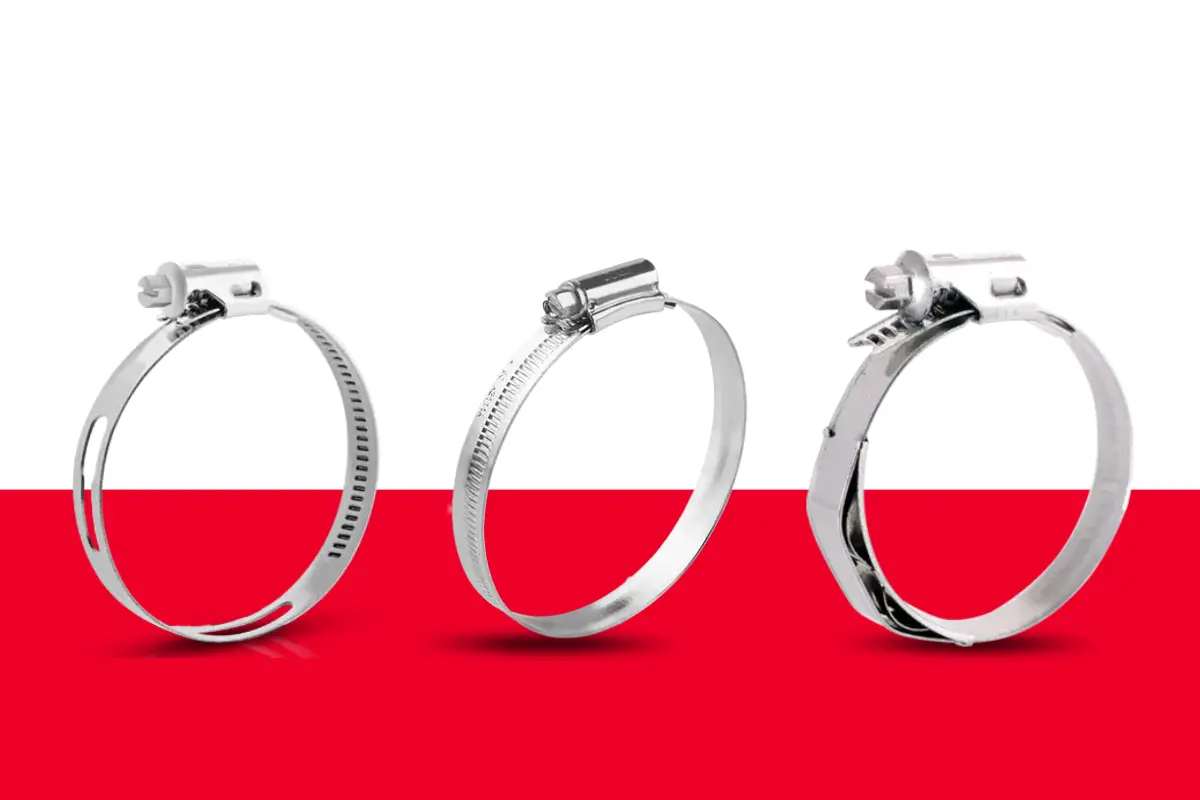
A hose connection starts to leak.
You tighten the clamp.
A few weeks later the same spot leaks again.
This happens often with low quality serrated worm-drive clamps in high-vibration or high-pressure setups.
Serrated hose clamps from Jolly Clamps solve this problem. They hold better and reduce leaks. In this post I explain how they work, what benefits they give, the main types, and what is new in 2026.
What Is a Serrated Hose Clamp?
A serrated hose clamp looks like a normal worm-drive clamp. It has a stainless-steel band, a housing, and a screw. The difference is in the band.
The band has small serrations stamped on the inner surface. These serrations work with the screw thread. When you turn the screw, the serrations lock into the hose. This gives a full 360-degree grip. Serrated clamps add a mechanical lock.
Jolly Clamps makes these to DIN 3017 standards. The main types are:
- WN Series – Worm Drive Serrated: Light-duty option in plated carbon steel. Economical choice for low-pressure jobs.
- FS Series – One Way Serrated: Smooth inner surface. Good for soft hoses like nitrile or silicone. It does not cut or damage the hose.
- FD Series – Two Way Serrated: Serrations on the inner surface. Good for harder hoses like EPDM or reinforced types. It stops seepage.
All types use one-piece housing. You can order them in many sizes or ask for custom diameters.
How Serrated Clamps Work on the Job
The clamp works by worm-gear action. The screw thread turns against the serrations on the band. This pulls the band tight around the hose.
The serrations spread the force evenly. This stops the band from slipping under vibration or pressure.
In soft-hose applications the FS series keeps the inner surface smooth so the hose lasts longer. In hard-hose applications the FD series grips firmly and cuts down on leaks.
Benefits of Serrated Hose Clamps
Serrated clamps give these results in daily use:
- Better hold when equipment vibrates.
- Less chance of leaks on pressure lines.
- Longer hose life because edges are rolled smooth.
- Simple choice between 202, 304, 316 or 430 stainless steel depending on the environment.
Manufacturing plants use them on coolant lines, fuel lines, hydraulic lines, and process pipes. They need fewer retightening visits.
Where These Clamps Fit Best
| Feature | FS Series (One-Way Serrated) | FD Series (Two-Way Serrated) | WN Series (Worm Drive Serrated) |
| Best Suited For | Soft hoses (nitrile, silicone, rubber) | Hard & reinforced hoses (EPDM, PTFE, braided) | Light-duty and low-pressure applications |
| Grip Style | One-way serrations – smooth inner surface | Two-way serrations – strong circular grip | Serrated band with standard worm drive |
| Key Benefit | Excellent hose protection with secure hold | Superior grip and excellent leak prevention | Reliable serrated performance at economical price |
| Hose Protection | Very high (rolled edges, minimal damage) | High (even pressure distribution) | Good |
| Leak Prevention | Good | Excellent | Good for low-pressure lines |
| Vibration Resistance | Good | Excellent | Suitable for light vibration |
| Duty Level | Medium duty | Medium- to heavy-duty | Light duty |
| Material Options | SS 304, 430 or 316 | SS 304, 430 or 316 | Plated Carbon Steel or SS 202 |
| Standard Compliance | DIN 3017 | DIN 3017 | BS 5315 / IS 4762 / DIN 3017 |
| Typical Applications | Coolant lines, vacuum hoses, automotive soft hoses | Hydraulic lines, fuel lines, high-pressure systems | General industrial low-pressure connections |
| Main Advantage | Protects soft hoses while delivering strong grip | Maximum holding power and sealing on tough hoses | Cost-effective serrated solution |
Serrated clamps work well in any place that has movement or pressure.
You see them on automotive lines, agricultural machines, marine engines, chemical plants, and power equipment.
If a low-quality clamp needs frequent checks, a serrated version often fixes the issue.
What Is New in 2025–2026
Jolly Clamps has added these updates:
- Spring-insert versions (SFS series). These keep steady tension when hose size changes because of heat.
- Wider band options for higher torque on larger hoses.
- More recyclable packaging and full stainless-steel options to meet environmental rules.
These changes make the clamps work better in hot or changing conditions without extra cost.
How to Pick the Right One
Ask three questions:
- Is the hose soft or hard?
- Soft hose → FS series.
- Hard or reinforced hose → FD series.
- What pressure and vibration level does the line see?
- Do you need stainless steel or carbon steel?
Send the hose outer diameter, pressure, and use details to the Jolly team. They return the exact part number and torque setting.
Final Point
The right clamp keeps the job simple. Serrated versions from Jolly Clamps add grip without changing how you install them.
Contact us for samples or data sheets.
