
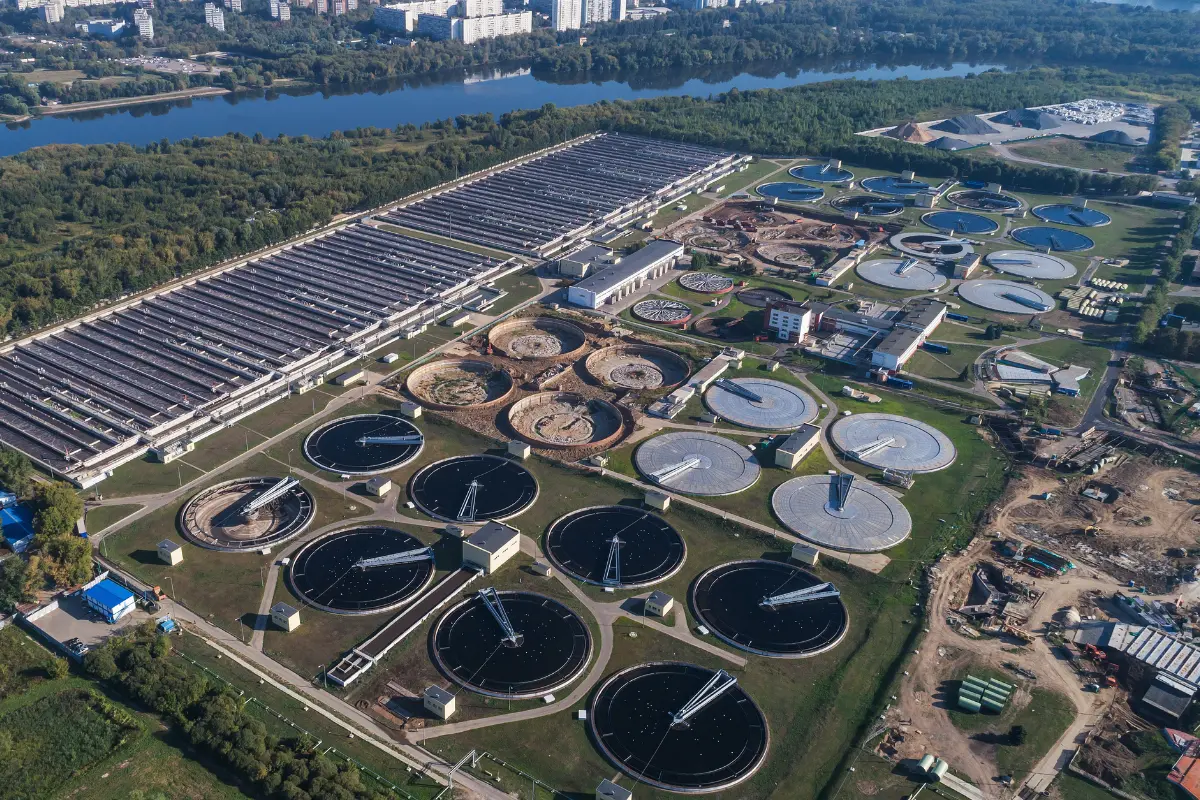
A 47 MLD sewage treatment plant runs on roughly ₹260 crore of concrete, blowers, membranes, pumps and SCADA. The clamps holding its pipework in place might account for 0.3% of that spend. Get them wrong, and you’ll be cutting seized fasteners out of a live aeration gallery in year four.
That gap between cost and consequence is the whole story of workholding and pipe support in water infrastructure. And right now, India is building more of this infrastructure than at any point in its history – which makes it worth understanding exactly where clamps fail and what to specify instead.
The scale of what’s being built
Urban India generates close to 48,000 MLD of sewage. Installed treatment capacity sits far below that. The government’s response has been the largest coordinated water infrastructure push the country has attempted.
AMRUT 2.0 carries an indicative outlay of ₹2.99 lakh crore, of which roughly ₹62,936 crore is sanctioned specifically for sewerage and septage work – a 29,105 km sewer network plus about 5,792 MLD of new treatment capacity.
Namami Gange has 524 projects sanctioned at around ₹43,030 crore, with 355 complete. Under Phase II alone, 218 sewerage projects worth ₹35,698 crore target 6,610 MLD of capacity, of which roughly 3,977 MLD across 138 STPs is already operational. The shift to the Hybrid Annuity Model matters more than the headline numbers: private operators now build and run these plants for 15 years, which means whoever builds the plant pays for every corroded support later.
Desalination has moved from pilot to mainstream. Chennai’s 400 MLD Perur plant – around ₹4,276 crore, JICA-funded, targeted for completion by end-2026 – will be among Southeast Asia’s largest seawater RO facilities. Gujarat and Tamil Nadu both have further capacity in the pipeline.
The EPC contractors executing these packages – VA Tech Wabag, L&T, and the mid-tier players bidding alongside them – are the people writing purchase orders for tens of thousands of pipe clamps, hose clamps and cable clamps per project. That is the customer.
Why SS 304 keeps failing in these plants
Here’s the technical heart of it. Sewage treatment and desalination create three environments that punish stainless steel:
- Hydrogen sulphide. Anaerobic zones, wet wells, and inlet works generate H₂S. In the presence of moisture it becomes sulphuric acid on any surface above the waterline.
- Chlorides. Seawater intake, brine reject, chlorinated final effluent, coastal humidity. Chlorides break down the passive oxide layer on stainless steel and start pitting.
- Constant wet-dry cycling. Splash zones, washdown areas, monsoon exposure. The worst possible condition for crevice corrosion under a clamp band.
SS 304 has no molybdenum. SS 316 carries 2–3% molybdenum, and that single addition is what holds the passive layer together in chloride service. It’s the difference between a support that lasts the 15-year O&M contract and one that fails inside 36 months.
| Material | Chloride resistance | H₂S / acidic service | Typical STP use | Realistic service life |
Hot-dip galvanised MS | Poor | Poor | Dry utility areas only | 3-7 years |
| SS 304 / 304L | Moderate | Moderate | Sludge handling, indoor dry piping | 5-10 years |
| SS 316 / 316L | High | Good | Aeration, dosing, effluent, wet wells, coastal plants | 15-25 years |
| SS 316 + PP/PA insert | High | Good | Vibration-prone and thermally cycling lines | 15-25 years |
| Duplex 2205 | Very high | Good | Brine reject, high-pressure SWRO racks | 25+ years |
Where the clamps actually go
Walk a plant and the demand becomes obvious. Each area has its own failure mode.
Inlet works and screening
Splash, grit, and H₂S. SS 316 heavy-duty pipe clamps to DIN 3015 Part 3 with SS 316 fasteners throughout – including the weld plate. Mixed-metal assemblies (SS band, MS bolt) fail at the bolt.
Aeration and blower headers
Blowers put continuous low-frequency vibration into air headers, and hot air lines expand. Rubber-cushioned or PP-lined clamps absorb vibration and allow axial movement without chafing the pipe. Rigid metal-on-metal clamping here is what causes fretting and eventual pipe wall failure.
Chemical dosing skids
Alum, polymer, sodium hypochlorite, ferric chloride. Small-bore PVC, PP and PTFE tubing, aggressive chemicals, tight spaces. SS 316 twin-series clamps and T-bolt hose clamps, plus SS 316 quick-release band clamps for lines that get stripped and cleaned.
Membrane and RO racks
High-pressure headers, permeate and brine lines, and the tightest tolerance requirements in the plant. SS 316 as a minimum; duplex on brine reject where the chloride concentration is several times seawater.
Wet wells and pump stations
Submersible pump power and control cables need SS 316 cable clamps and cable ties. This is one of the most commonly under-specified items on any STP bill of materials – nylon ties in a wet well are a maintenance ticket waiting to happen.
Outfall and coastal exposure
Marine atmosphere, permanent salt spray. SS 316 with SS 316 anchoring hardware, no exceptions.
Vacuum sewerage: a small market with unusually strict requirements
Vacuum sewerage is India’s most interesting emerging niche. Panaji commissioned the country’s first vacuum sewer network under AMRUT – an ₹8.52 crore project serving over 200 households in low-lying areas of Mala and St Inez – following an earlier pilot near the Taj Mahal in Agra. The logic is compelling: shallow trenches, small-diameter pipes, minimal excavation, and it works where high water tables and narrow lanes defeat gravity sewers. Coastal Kerala, Goa, backwater towns, and dense heritage cores are natural candidates.
For clamping, vacuum systems change one thing fundamentally. A gravity sewer leaks outward. A vacuum sewer leaks inward. Any air ingress at a joint degrades vacuum across the entire network, and the pumps at the vacuum station run harder to compensate. Every fitting has to stay leak-tight for decades.
That puts real demands on the hardware:
- Support spacing and rigidity. Sawtooth-profile pipe runs must hold their gradient. Sagging between supports traps liquid and kills conveyance.
- Restraint against pressure cycling. Vacuum mains see repeated pressure transients every time an interface valve fires. Supports need to resist working loose, not just hold static weight.
- Valve pit hardware. Interface valve mounting brackets and controller clamps sit in a permanently damp, H₂S-rich chamber. SS 316 or nothing.
- Vacuum station piping. Pump suction manifolds and collection vessel connections, all under continuous negative pressure and vibration.
Get in early on these projects and you’re specified into a technology that’s about to be replicated across every flood-prone Indian town that’s tried gravity sewerage and failed.
Specification checklist for water and wastewater projects
Before releasing any clamping package for an STP, WTP or desalination plant:
- Is every component 316 — band, insert cup, bolt, nut, washer, weld plate? One 304 bolt compromises the assembly.
- Welded or bolted? Welded connections call for 316L.
- Has the chloride concentration been checked at each location, not just averaged across the plant?
- Are vibration sources identified, and are cushioned clamps specified on blower, pump and compressor lines?
- Does thermal movement need to be accommodated, or will you be replacing chafed pipe in year three?
- Are cable clamps and ties included? They’re routinely forgotten, then substituted with nylon on site.
- Is there test documentation – material test certificates, salt-spray results, and PMI reports? On HAM-model projects the O&M operator will ask.
- Can the supplier deliver against project schedules? A ₹300 crore STP does not wait for clamps.
The takeaway
India’s water infrastructure spending isn’t a cycle – it’s a structural shift, and the Hybrid Annuity Model has permanently changed who bears the cost of a cheap support. Build the plant, run it for 15 years and replace anything that corrodes out of your own margin. That single contractual change turns a low-value line item into a specification decision worth arguing about.
Specify SS 316 once. Or specify SS 304 and pay for it three times.
Working on an STP, water treatment or desalination package? Send us your pipe schedule and site conditions, and our team will put together a clamping specification – grade, series, insert material and quantities – for your bill of materials. Get in touch with Jolly Clamps to talk it through.
