
If you work with exhaust systems, turbo setups, diesel particulate filters, or high-pressure process piping, you know the pain of leaky flanges, seized bolts, and hours lost to maintenance.
V-band clamps solve that.
What began as a 1941 aerospace fix has become a go-to solution across automotive, power generation, oil & gas, and heavy manufacturing. At Jolly Clamps we’ve manufactured premium stainless-steel V-band clamps for over 55 years, and engineers still tell us the same thing after their first install: “This changes everything.”
Here’s the full story: how V-band clamps evolved, what makes them outperform traditional bolted flanges, and why they deliver rock-solid reliability in the toughest conditions you’ll ever face.
The History of V-Band Clamps: From Wartime Invention to Industrial Standard
The V-band clamp was invented in 1941 by Herbert “Zeppo” Marx (yes, the youngest Marx Brother) through his company in Inglewood, California.
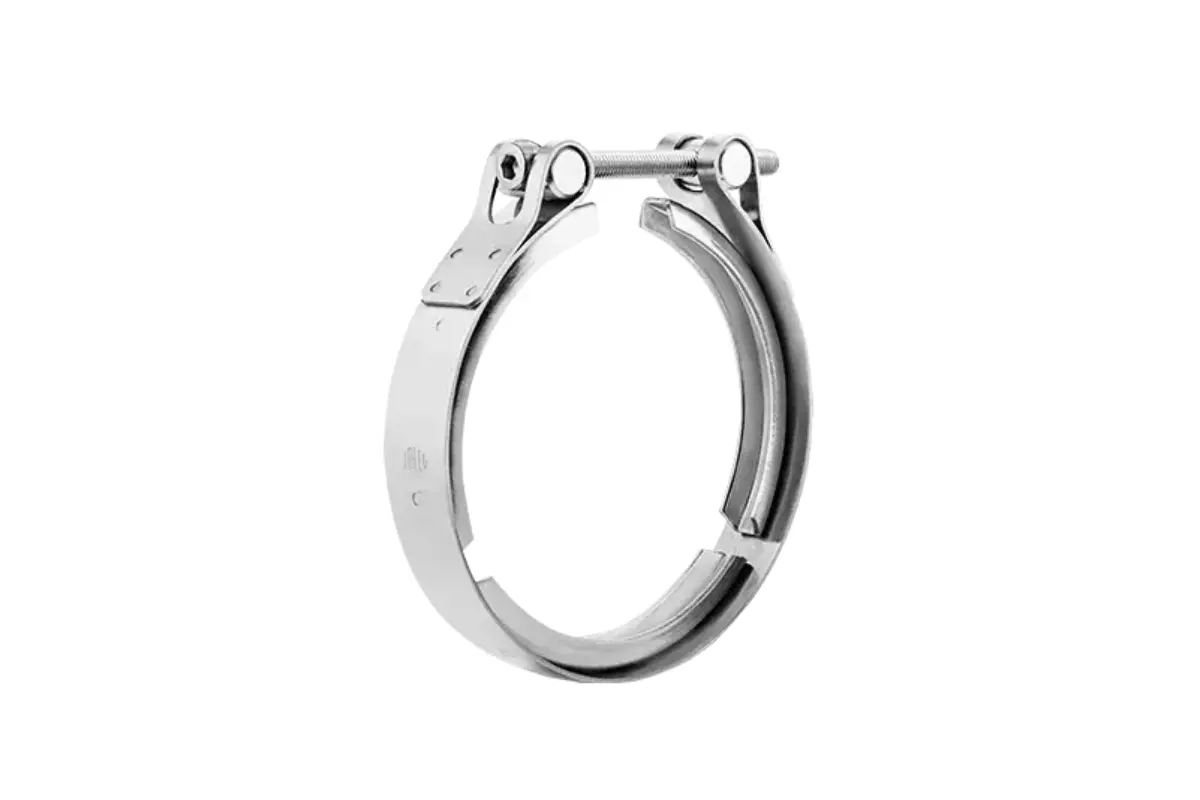
The design was straightforward and brilliant: a circular band with an internal V-groove that mates perfectly with matching flanges on two pipe ends. Tighten one T-bolt or quick-release latch, and the band pulls the flanges together with uniform radial force around the full 360° circumference. No multiple bolts. No gaskets in many cases. Just a clean, metal-to-metal seal that handles extreme vibration and temperature swings.
Its first major job? Securing the atomic bomb casing inside the Enola Gay in 1945. The same technology later flew on John Glenn’s orbital mission. By the 1970s and 1980s, racing teams adopted it for quick pit-stop exhaust changes. In the 2000s it moved into commercial diesel after-treatment systems, and today it’s standard in everything from truck DPF assemblies to combined-cycle power plant piping.
How V-Band Clamps Work (Simple Engineering That Delivers Results)
Two pipe ends have machined flanges with a V-shaped outer profile. Slide the V-band clamp over them, align everything, and torque the latch. The band’s inner V-groove wedges the flanges together evenly.
You get:
- Consistent clamping pressure with zero high or low spots
- A seal that stays tight as pipes expand and contract with heat
- One-tool (or hand) release for fast service
Compare that to a traditional flange with 8–12 bolts. One loose bolt risks a leak. One seized bolt means cutting hardware and extra downtime.
V-Band Clamps Evolution: Key Milestones from 1941 to 2026
1940s–1960s
Aerospace and military use. Stainless-steel bands with basic T-bolt latches. Weight savings and zero-failure reliability were non-negotiable.
1970s–1990s
Motorsports and performance exhausts. Flange designs improved (bulge-formed and machined versions), and higher-grade stainless handled 800 °C+ temperatures.
2000s–2010s
Industrial adoption in power generation, oil & gas, and commercial vehicles. Quick-release saddle and Allen-bolt styles slashed maintenance times on DPF and SCR systems.
2020s–2026
Lightweight alloys, corrosion-resistant coatings, and sensor-ready options meet stricter emissions rules and sustainability targets. Titanium versions (introduced around 2023) cut weight by up to 30% while surviving 700°C spikes. Some designs now include mounting points for real-time tension monitoring — perfect for predictive maintenance in Industry 4.0 plants.
Market numbers confirm the momentum. The global V-band clamps market sits at approximately USD 489.11 million in 2026 and is forecast to reach USD 648.86 million by 2035, growing at a steady 3.1 % CAGR. Growth comes from electric and hybrid vehicle thermal management, tighter emissions regulations, and the push for lighter, more recyclable components.
V-Band Clamps Advantages: Why Engineers Switch and Never Go Back
On the plant floor or under the hood, these benefits actually matter:
- Faster assembly and disassembly – One latch instead of eight bolts. Service times drop by up to 70 % on turbo or DPF jobs.
- Superior sealing – Uniform 360° force creates a leak-free joint, often without gaskets. Ideal for high-pressure exhaust, steam, or fluid lines.
- Vibration resistance – Radial design spreads forces evenly and reduces fatigue cracks.
- Weight and space savings – No bulky bolt circles. Perfect for tight engine bays or crowded skids.
- Reusability – Install and remove dozens of times with the same clamp — no distorted gaskets or stretched bolts.
- High-temperature performance – Stainless grades handle continuous 650–800 °C; titanium options go higher while staying lighter.
Side-by-side testing shows V-band joints beat traditional flanges in leak rate and fatigue life under thermal cycling and vibration.
V-Band Clamps vs Traditional Bolted Flanges: How They Stack Up
Here’s a clear head-to-head look at what really matters in daily use:
- Assembly time
V-Band Clamps: 1–2 minutes (one latch)
Traditional Bolted Flanges: 10–20 minutes (multiple bolts)
- Sealing performance
V-Band Clamps: Uniform 360° pressure
Traditional Bolted Flanges: Point-loaded; gasket often required
- Vibration resistance
V-Band Clamps: Excellent (radial force)
Traditional Bolted Flanges: Good, but prone to loosening
- Weight
V-Band Clamps: Significantly lighter
Traditional Bolted Flanges: Heavier due to bolt circle
- Reusability
V-Band Clamps: Dozens of cycles, same clamp
Traditional Bolted Flanges: Gaskets distort; bolts stretch
- Maintenance cost
V-Band Clamps: Lower (fewer parts, faster service)
Traditional Bolted Flanges: Higher (more hardware, longer downtime)
- Temperature tolerance
V-Band Clamps: Up to 800 °C+ (stainless/titanium)
Traditional Bolted Flanges: Limited by gasket material
What Makes V-Band Clamps Truly Reliable in the Field
Reliability comes down to measurable performance:
- Even load distribution – V-groove geometry eliminates bolt-hole stress that cracks conventional flanges.
- Material quality – We use 304 and 316 stainless (plus higher-nickel alloys on request) with precise heat treatment so the band keeps its tension after years of thermal cycling.
- Latch engineering – T-bolt, saddle-type quick-release, and Allen-bolt designs are torque-rated and fatigue-tested.
- Proven track record – Millions of service hours in nuclear transport casks, offshore platforms, and heavy-duty trucks – environments that destroy lesser hardware.
A good V-band clamp doesn’t just hold. It keeps holding after 500 thermal cycles, after a decade of road salt, or after a major storm shakes the entire platform.
2026 Trends: Where V-Band Clamp Technology Is Heading
The industry keeps moving. Look for:
- Titanium and advanced stainless alloys for weight-critical EV battery-cooling loops and aerospace ducting.
- Integrated sensors that alert you to loose clamps before leaks develop.
- Recyclable clamp-and-flange kits that help plants hit Scope 3 carbon targets.
- Hybrid quick-release designs that combine saddle-clamp speed with extra security options.
At Jolly Clamps we’re already shipping DPF-specific V-bands (DTV series), saddle-type quick-release (QTV), and compact connecting-link models (VCL) built for exactly these needs.
How to Choose the Right V-Band Clamps for Your Application
Match the clamp to your operating conditions:
- Temperature – Stainless for up to 800°C; titanium for extreme heat plus weight savings.
- Pressure & vibration – Heavier-duty bands with wider profiles for high-vibration diesel or power plant lines.
- Quick service – saddle or quick-release latches for frequent maintenance.
- Size & material – Standard 304/316 stainless for most industrial jobs; higher alloys for corrosive environments.
Our team has supported everything from Mumbai refineries to European racing teams. Tell us your pipe size, temperature, and pressure, and we’ll recommend the exact part first time.
Ready to Upgrade Your Next Project?
Whether you’re specifying V-band clamps for a new turbo installation, retrofitting an ageing power plant, or designing emission-compliant equipment, a properly engineered V-band clamp gives you faster assembly, fewer leaks, and lower lifetime costs.
Browse our full range of industrial V-band clamps – standard couplings, heavy-duty quick-release, and DPF-specific models – right here on the Jolly Clamps website.
Need help selecting the right size, material, or latch style? Drop us a message. Our engineers will get you the right V-band clamp solution immediately.
Because in industrial connections, “good enough” is never good enough.
